
Search All Items
- Filters:
- Language
- English 6457
- Spanish 23
- ENGLISH 2
- English 2
- census_013 1
- contra_costa_schedule_1_volume_1 1
- Type
- Image 3882
- Still Image 2094
- Text 445
- Text 54
- Textual 2
- Image of the California Census from the records of the office of the California Secretary of State 1
Search Results 6431 to 6440 of 6559
-
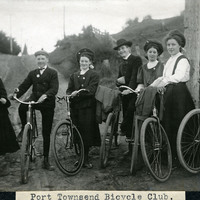
Caption: "Port Townsend Bicycle Club.," c. 1910. Seven unidentified men and women posing with bicycles. The bicycle made its first appearance in the Puget Sound area in the late 1870s. Within twenty years, thousands of enthusiasts had adapted the new mode of transportation. Such enthusiasts often formed clubs, such as the Queen City Good Roads Club, based in Seattle (south of Port Townsend). These clubs advocated, constructed, and helped to maintain pathways dedicated specifically to bicycle traffic. Ironically, the efforts made by the bicyclists to generally improve roadways contributed to the rise of another new mode of transportation -- the automobile.
Date: 1910
-
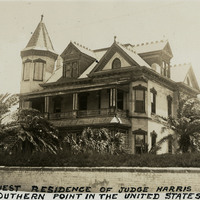
Caption: "Key West Residence of Judge Harris, Most Southern Point in the United States July 2, 1934." View of the Queen Anne-style Victorian mansion constructed in Key West by Judge Vinning Harris in 1897. The home was originally touted as occupying the southernmost point in the U.S., resulting in the colloquial name "Southernmost House." During the Prohibition years (1920-1933) the house operated as a speakeasy, with a restaurant and casino. In 1939, it was converted to use as a nightclub. Today, it has been renovated for use as a bed-and-breakfast.
Date: 7/2/1934
-
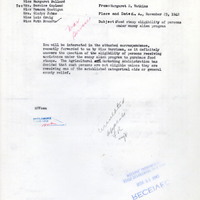
Office Memorandum from Margaret S. Watkins to Margaret Bullard, et al. regarding eligibility for food stamps
Date: November 23, 1942
-
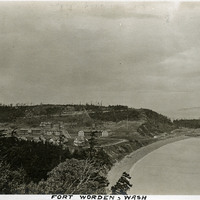
Caption: "Fort Worden, Wash.," c. 1909. Panoramic view of Fort Worden in Port Townsend, Washington, on Admiralty Inlet of Puget Sound. Construction began on the fort in 1898. By 1902 it was serving as an active U.S. Army base. Fort Worden was part of the "triangle of fire," three coastal defense fortifications (Fort Casey, Fort Worden, and Fort Flagler) guarding the entrance to Puget Sound. The U.S. sold the property to the state of Washington in 1957. In 1973, the fort and surrounding area opened as Fort Worden State Park.
Date: 1909
-
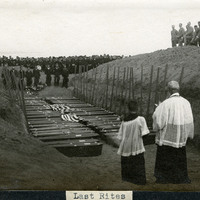
Caption: "Last Rites." Shows a grave site with dozens of caskets ready for burial. A priest and two altar boys stand at one side of the caskets, while a large group of U.S. Navy sailors looks on from the other side. While sailing from port in San Diego on the morning of July 21, 1905, the boiler of the USS Bennington exploded, killing sixty-six of her crew. The victims were laid to rest in the cemetery at Fort Rosecrans. See also 96-07-08-alb05-142 and 96-07-08-alb08-222.
Date: 1905-07-23
-
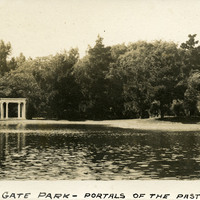
Caption: "Golden Gate Park -- Portals of the Past," c. 1910. A monument in Golden Gate Park in San Francisco, on the shores of Lloyd Lake, consisting of a white marble archway and columns. The archway was originally part of the Nob Hill mansion belonging to railroad tycoon Alban Towne. The mansion was destroyed in the 1906 San Francisco earthquake and fire, but the entryway still stood. It was moved to the shore of Lloyd Lake in 1909, as a memorial to the pre-1906 city.
Date: 1910
-
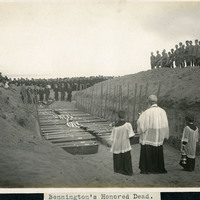
Caption: "Bennington's Honored Dead." Shows a grave site with dozens of caskets ready for burial. A priest and two altar boys stand at one side of the caskets, while a large group of U.S. Navy sailors looks on from the other side. While sailing from port in San Diego on the morning of July 21, 1905, the boiler of the USS Bennington exploded, killing sixty-six of her crew. The victims were laid to rest in the cemetery at Fort Rosecrans. See also 96-07-08-alb05-142 and 96-07-08-alb08-217.
Date: 1905-07-23
-
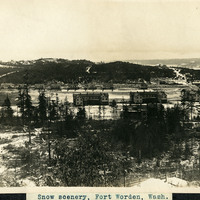
Caption: "Snow scenery, Fort Worden, Wash.," c. 1908. Overview of Fort Worden in Port Townsend, Washington, on Admiralty Inlet of Puget Sound. Construction began on the fort in 1898. By 1902 it was serving as an active U.S. Army base. Fort Worden was part of the so-called "triangle of fire," three coastal defense fortifications (Fort Casey, Fort Worden, and Fort Flagler) guarding the entrance to Puget Sound. The U.S. sold the property to the State of Washington in 1957. In 1973, the fort and surrounding area opened as Fort Worden State Park.
Date: 1908
-
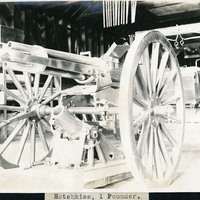
Caption: "Hotshkiss [sic], 1 pounder." The United States purchased artillery from the French arms firm, Hotchkiss, in the late 19th and early 20th centuries. The arms firm was created by American gunsmith, Benjamin B. Hotchkiss, who moved to France in 1867 to set up the factory. The heavy artillery was first used by the United States against the Nez Perce in 1877. In 1890, they were used at the Wounded Knee Massacre, and also for the attack on San Juan Hill during the Spanish-American War.
Date: Undated
-
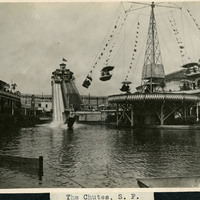
Caption: "The Chutes, S. F.," c. 1905. View of the Fulton Street Chutes, a 350-foot water slide. Boats or toboggans careened down the slide into a man-made lake at the bottom. Such "chutes" were very popular throughout the U.S. and Europe at the turn of the century. The Fulton Street Chutes operated from 1902-1907 as part of an amusement park area that also featured the "Circle Swing Flying Machine" (also visible in the photograph), a theater, bar, merry-go-round, and a zoo.
Date: 1905