
Search All Items
- Filters:
- Language
- English 6457
- Spanish 23
- ENGLISH 2
- English 2
- census_013 1
- contra_costa_schedule_1_volume_1 1
- Type
- Image 3882
- Still Image 2094
- Text 445
- Text 54
- Textual 2
- Image of the California Census from the records of the office of the California Secretary of State 1
Search Results 6441 to 6450 of 6559
-
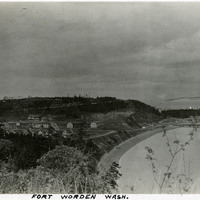
Caption: "Fort Worden Wash.," c. 1909. Fort Worden in Port Townsend, Washington, on Admiralty Inlet of Puget Sound. Construction began on the fort in 1898. By 1902 it was serving as an active U.S. Army base. Fort Worden was part of the "triangle of fire," three coastal defense fortifications (Fort Casey, Fort Worden, and Fort Flagler) guarding the entrance to Puget Sound. The U.S. sold the property to the State of Washington in 1957. In 1973, the fort and surrounding area opened as Fort Worden State Park.
Date: 1909
-
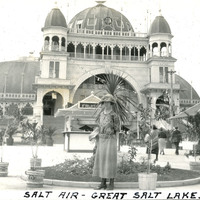
Caption: "Salt Air - Great Salt Lake," c.1923. Grace McCarthy poses in front of the Saltair resort complex on Utah's Great Salt Lake. Constructed in 1893 and designed by Richard K.A. Kletting, the Saltair set out to be the Western counterpart of Coney Island. The resort was a popular spot for Mormon families, only fifteen miles from Salt Lake City and overseen by Church leaders. The Church sold the building in 1906. It was later destroyed by fire in 1925, but a second pavilion was quickly built.
Date: 1923
-
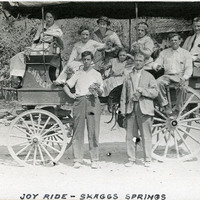
Caption: "Joy Ride -- Skaggs Springs," c. 1914. William (standing in front to the right) and Grace (third from the left in the wagon) McCarthy and a group of unidentified people all holding bunches of grapes, either getting ready for or coming back from a ride in a horse-drawn wagon. Skaggs Springs was a resort area along the Russian River in Sonoma County, known for its hot springs. The area now lies beneath the waters of Lake Sonoma, flooded after construction of the Warm Springs Dam, completed in 1982.
Date: 1914
-
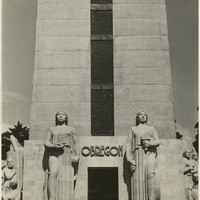
Caption: "Obregon's tomb, Mexico City." William and Grace McCarthy standing before the monument to General Alvaro Obregon (1880-1928), who was a leader of the Mexican Revolution (1920-1920). Obregon was elected President of post-Revolution Mexico, serving from 1920-1924. In 1928, he was again elected but was assassinated by Jose de Leon Toral, a Roman Catholic who opposed Obregon's policies on religious matters. The monument was completed in 1935 and stands in the San Angel region of Mexico City, in the same location where Obregon was assassinated.
Date: 1938
-
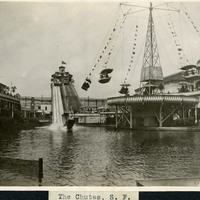
Caption: "The Chutes, S.F," c. 1905. View of the Fulton Street Chutes, a 350-foot water slide. Boats or toboggans careened down the slide into a man-made lake at the bottom. Such "chutes" were very popular throughout the U.S. and Europe at the turn of the century. The Fulton Street Chutes operated from 1902-1907 as part of an amusement park area that also featured the "Circle Swing Flying Machine" (also visible in the photograph), a theater, bar, merry-go-round, and a zoo.
Date: 1905
-
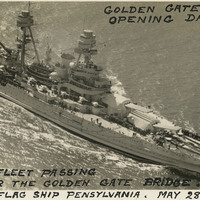
Caption: "Golden Gate Bridge Opening Day. U.S. Fleet Passing Under the Golden Gate Bridge. U.S. Flag Ship Pennsylvania [sic]. May 28, 1937." View of the super-dreadnaught battleship USS Pennsylvania as she passed under the Golden Gate Bridge as part of the celebrations surrounding the bridge's opening day. The third U.S. Navy ship named for the state of Pennsylvania, she was launched in 1915. The Pennsylvania served in both the Atlantic and Pacific Fleets, and was damaged while in dry-dock during the attack on Pearl Harbor in 1941. After being repaired, she spend the remainder of World War II in the Pacific Theater. Hit by a torpedo in August 1945, the severely damaged Pennsylvania was repaired well enough to serve as a target ship during Operation Crossroads atomic bomb tests off Bikini Atoll in July 1946. She was decommissioned that year, and after undergoing radiation testing, was scuttled by the U.S. Navy in February 1948.
Date: 5/28/1937
-
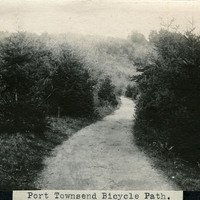
Caption: "Port Townsend Bicycle Path.," c. 1910. Image of a rural path or road, surrounded by trees and vegetation, with a hill in the distance. The bicycle made its first appearance in the Puget Sound area in the late 1870s. Within twenty years, thousands of enthusiasts had adapted the new mode of transportation. Such enthusiasts often formed clubs, such as the Queen City Good Roads Club, based in Seattle (south of Port Townsend). These clubs advocated, constructed, and helped to maintain pathways dedicated specifically to bicycle traffic. Ironically, the efforts made by the bicyclists to generally improve roadways contributed to the rise of another new mode of transportation -- the automobile.
Date: 1910
-
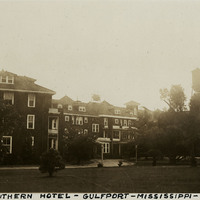
Caption: "Great Southern Hotel -- Gulfport -- Mississippi -- June 19, 34." The Great Southern Hotel, built in 1902-1903 by entrepreneur Joseph T. Jones (also the founder of Gulfport), offered luxurious amenities such as telephones in each room, baths, hot and cold running water, billiards, gardens, and a tennis court. The hotel was hit hard by the Great Depression in the 1930s, even closing briefly. After a short-lived revival in the 1940s, the hotel was demolished in 1951 to make way for U.S. Highway 90.
Date: 6/19/1934
-
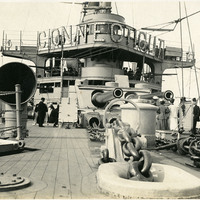
No caption. A view of the deck of the USS Connecticut, c. 1908. The Connecticut was commissioned on September 29, 1906 as the most advanced ship in the U.S. Navy. Because the provisions of the Washington Naval Treaty of 1922 stipulated that older battleships would be disposed of, the USS Connecticut was decommissioned and sold for scrap in 1923.
Date: 1908
-
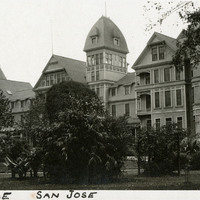
Caption: "Vendome San Jose," c. 1910, was a luxury hotel in San Jose that opened in 1889. It was purchased by a real estate syndicate in 1930 and subsequently demolished in order to subdivide the property into lots for residential housing.
Date: 1910