
Search All Items
- Filters:
- Type
- Image 3882
- Still Image 2127
- Text 433
- Text 50
- Image of the California Census from the records of the office of the California Secretary of State 1
- Language
- English 6465
- Spanish 33
- ENGLISH 2
- English 2
- census_013 1
- contra_costa_schedule_1_volume_1 1
Search Results 6441 to 6450 of 6569
-
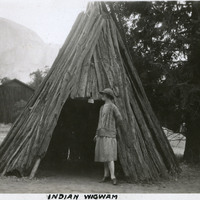
Caption: "Indian Wigwam," c. 1917. Grace McCarthy poses at the entrance to what William McCarthy labeled a "wigwam," a dwelling of the Ahwahnechee people. The Ahwahnechee (a Native American tribe who traditionally occupied the Yosemite Valley) called the dwellings o-chum. Pine branches were arranged in a tee-pee-like shape and then covered with layered slabs of cedar bark.
Date: 1917
-
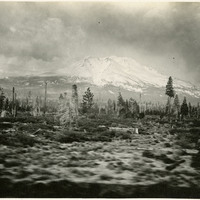
No Caption: c. 1910. View of Mount Shasta, at the southern end of the Cascade Range, looking east. Mount Shasta has an elevation of 14,179 feet, making it the fifth-highest peak in California. It is also rated as a potential high-risk volcano by the U.S. Geological Survey, and is part of the eastern rim of the Pacific Ring of Fire.
Date: 1910
-
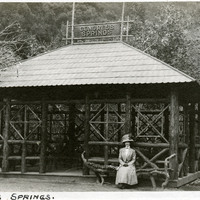
Caption: "Congress Springs.," c. 1910. Grace McCarthy seated on an unusual bench made from a tree branch and logs, in front of a timber shelter at Pacific Congress Springs near Saratoga in California's Santa Clara Valley. Pacific Congress Springs, a mineral spring named after Congress Springs in New York, operated as a resort area from the nineteenth century until the 1930s.
Date: 1910
-
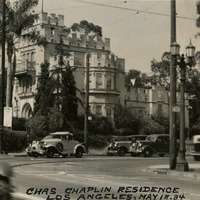
Caption: "Chas Chaplin Residence Los Angeles, May 18, 1934." View of a castle-like building, with crenellated parapets and a tower. William McCarthy labeled this as a residence of Charlie Chaplin. The sign in front appears to indicate that the building is a church rather than a residence, but is difficult to read.
Date: 5/18/1934
-
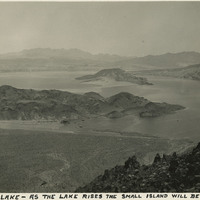
Caption: "Boulder Lake [Lake Mead] - as the lake rises the small island will be submerged," c. 1935. Lake Mead was created by the construction of Boulder (Hoover) Dam, and is the largest man-made reservoir (when full) in the United States.
Date: 1935
-
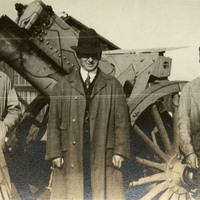
No caption, c. 1917. William McCarthy (center) standing with the unidentified crew of a 6" Howitzer at Camp Kearney. Camp Kearney was established by the U.S. Army in 1917 just north of San Diego. The post was largely abandoned by the government in 1920, used as a military and civilian airfield. It did not see increased military service again until the 1930s.
Date: 1917
-
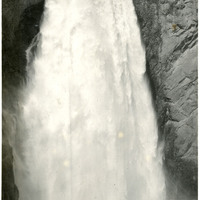
Caption: "Lower Falls," c. 1923. As the Yellowstone River flows north from Yellowstone Lake it passes over two waterfalls (Upper and Lower Yellowstone Falls) before reaching the Yellowstone Grand Canyon. This photograph shows the 308-foot Lower Yellowstone Falls, as viewed from the base of the falls. It carries more water volume than any other waterfall in the Rocky Mountains.
Date: 1923
-
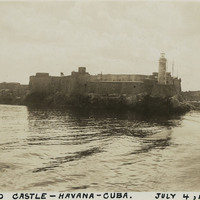
Caption: "Morro Castle -- Havana -- Cuba. July 4, 1934." Morro Castle, also called Castillo de los Tres Reyes Magos del Morro, has guarded the entrance to Havana's harbor since 1589. Various additions have been built over the years, including the Faro Castillo del Morro Lighthouse, added in 1846. Morro Castle currently houses the offices of the Havana Harbormaster, and operates as a museum.
Date: 7/4/1934
-
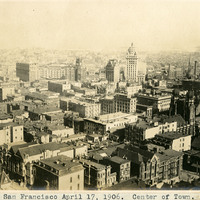
Caption: "San Francisco April 17, 1906. Center of Town." Bird's eye view of the center of San Francisco before the 1906 earthquake and fire. The Call Building (built in the 1890s to house the San Francisco Call newspaper) is the tallest building in the photograph, just to the right of center. See also 96-07-08-alb02-026.
Date: 4/17/1906
-
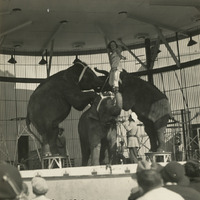
Caption: "Chicago Fair, Sept. 23, 1934." Three elephants performing in a circus ring at Chicago's Century of Progress Exposition. The Exposition, a world fair attended by thirty-nine million people, celebrated Chicago's one-hundred year anniversary of incorporation. Originally planned to only run from May to November in 1933, it was such a success that its organizers decided to keep it running for a second season from May through October the following year. The central theme of the Exposition was technological innovation, with a motto of "Science Finds, Industry Applies, Man Conforms."
Date: 9/23/1934