
Search All Items
- Filters:
- Language
- English 6457
- Spanish 23
- ENGLISH 2
- English 2
- census_013 1
- contra_costa_schedule_1_volume_1 1
- Type
- Image 3882
- Still Image 2094
- Text 445
- Text 54
- Textual 2
- Image of the California Census from the records of the office of the California Secretary of State 1
Search Results 6491 to 6500 of 6559
-
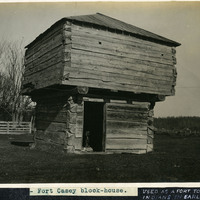
Caption: "Fort Casey block-house." and "USED AS A FORT TO FIGHT INDIANS IN EARLY DAYS," c. 1908-1912. View of a blockhouse, a timber structure built by European settlers to guard against attack during the Indian Wars of 1855-1857. See also 96-07-08-alb08-067.
Date: 1908
-
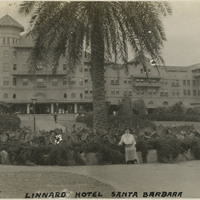
Caption: "Linnard Hotel Santa Barbara.", c. 1920. Grace McCarthy sitting in front of the Hotel Potter. Opened in 1903 by Milo M. Potter, the hotel sold in 1919 to the Santa Barbara Hotel Company, controlled by D.M. Linnard. The famous luxury resort burned down in 1921. See also 96-07-08-alb05-070, and 96-07-08-alb04-097.
Date: 1920
-
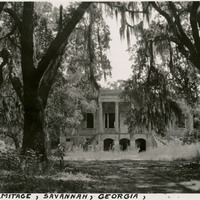
Caption: "Old Hermitage, Savannah, Georgia, July 15, 1934." The remains of the Hermitage Plantation mansion, built in 1830, can be seen through trees draped with Spanish moss. Hermitage was a 400-acre plantation on the Savannah River, owned by Henry McAlpin. McAlpin not only conducted farming operations at the planation, but also manufactured bricks, barrels, cast iron products, and lumber.
Date: 7/15/1934
-
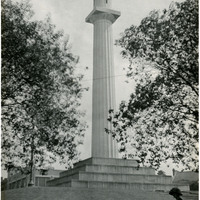
Caption: "Robert E, Lee Statue - New Orleans," c. 1925. The Robert E. Lee Memorial in New Orleans was dedicated in 1884. Architect John Ray designed the base and pedestal, while sculptor Alexander Doyle was responsible for the statue itself. The monument commemorated the memory of Confederate General Robert E. Lee, until its removal in 2017.
Date: 1925
-
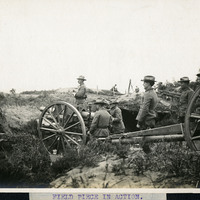
Caption: "Field Piece in Action." Unidentified location, c. 1905-1915. Shows a crew of men operating a 3" field gun, a heavy artillery gun set onto a carriage for mobile use. The U.S. military used these guns between 1905 and 1919, gradually phasing them out of use during the 1920s in favor of more modern weapons.
Date: 1915
-
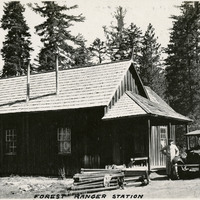
Caption: "Forest Ranger Station," c. 1917. Grace McCarthy (in the driver's seat of the automobile) and an unidentified man taking a break from driving by pausing next to a small plank house, identified as a forest ranger station by William McCarthy.
Date: 1917
-
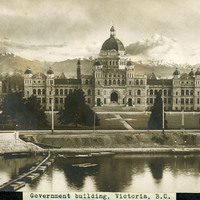
Caption: "Government building, Victoria, B.C.," c. 1908-1912. View of the British Columbia Parliament Buildings in Victoria. Designed by Francis Rattenbury, the construction began on the complex in 1893 and finished four years later. The buildings were first used in 1898.
Date: 1908
-
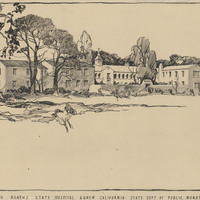
Caption: "Ward - Kitchen & Steam Plant Building, Agnews State Hospital Agnew California - State Dept. of Public Works Division of Architecture." Pen and ink drawing of ward buildings, Agnews State Hospital, by Alfred Eichler. Built. Design by H. S. Hazen in the "Spanish Style" introduced by George Washington Smith. Project for Department of Mental Hygiene - Hospitals.
Date: 1930
-
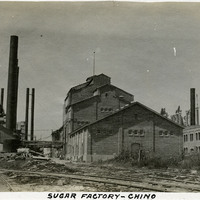
Caption: "Sugar Factory -- Chino," c. 1915. View of Chino's sugar beet factory, established in 1891 by Robert and Henry Oxnard. Henry later established a larger factory in the town that now bears his name (Oxnard, in Ventura County). The factory operated for more than twenty-five years before closing in October 1917.
Date: 1915
-
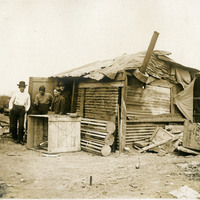
No Caption: See also 96-07-08-alb05-018 with caption: "Italian Refugee Hut S.F. 1906." Makeshift hut with four unidentified men standing in doorway. After the earthquake and fire that destroyed much of San Francisco in April 1906, hundreds of thousands of people were left homeless. Many of these people established temporary refugee camps, using debris from the destruction to cobble together shelters.
Date: 1906