
Search All Items
- Filters:
- Language
- English 6457
- Spanish 23
- ENGLISH 2
- English 2
- census_013 1
- contra_costa_schedule_1_volume_1 1
- Type
- Image 3882
- Still Image 2094
- Text 445
- Text 54
- Textual 2
- Image of the California Census from the records of the office of the California Secretary of State 1
Search Results 6511 to 6520 of 6559
-
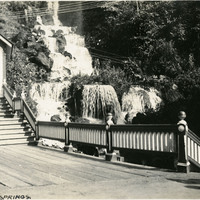
Caption: "Shasta Springs," Siskiyou County, California, c. 1906. Shasta Springs, just north of Dunsmuir, California, in the Trinity Mountains, was a resort area in the late nineteenth and early twentieth centuries. It centered around natural springs, which became a featured stop on the Southern Pacific Railroad's Shasta Route. The resort operated until the 1950s, when it was purchased by private interests.
Date: 1906
-
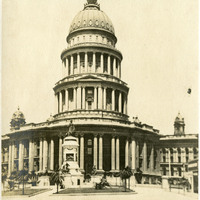
Caption: "Old City Hall Tower," San Francisco, c. 1905. A view of the San Francisco City Hall, built in 1870, before it was damaged beyond repair by the 1906 earthquake and fires. A new city hall, near the site of the original, was completed in 1916.
Date: 1905
-
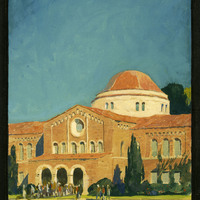
Color rendering of Chico State College Administration Building by Alfred Eichler. Design by H. S. Hazen. Drawing was made in 1928, before building was built. The dome shows the influence of the Westminster Presbyterian Church, 13th and N Streets, Sacramento, which had just been completed. Framed picture. Project for Department of Education.
Date: 1928
-
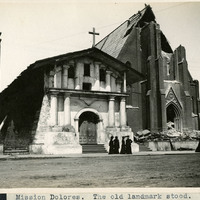
Caption: "Mission Dolores. The old landmark stood," 1906. Mission Delores, the oldest intact building still standing in San Francisco today, suffered little damage from the 1906 earthquake. The parish church next to it was greatly damaged and rebuilt as the Mission Dolores Basilica, opened in 1918.
Date: 1906
-
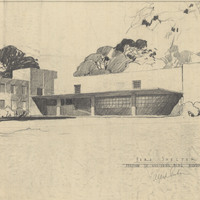
Caption: "Yard Shelter, Addition to Custodial Bldg. Mendocino, Ward 12." Design and drawing of addition to Custodial Building, Mendocino State Hospital, by Alfred Eichler. The addition added several custodial features, such as a cell block. Project for Department of Mental Hygiene - Hospitals.
Date: undated
-
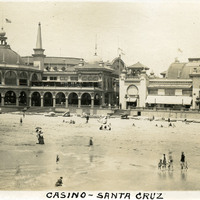
Caption: "Casino-Santa Cruz," c. 1910. A view of the beachside casino resort with many beachgoers enjoying the sand and water. The casino, designed by William Weeks, was constructed in 1907, replacing a previous casino building that burned down in 1906. See also 96-07-08-alb05-075.
Date: 1910
-
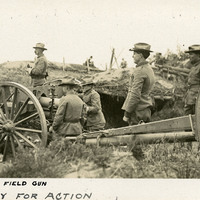
Caption: "A 3 inch Field Gun Ready for Action," c. 1915. Shows a crew of men operating a 3" field gun, a heavy artillery gun set onto a carriage for mobile use. The U.S. military used these guns between 1905 and 1919, gradually phasing them out of use during the 1920s in favor of more modern weapons.
Date: 1915
-
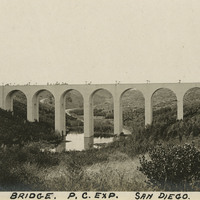
Caption: "Cabrilla [sic] Bridge. P.C. Exp. San Diego. July 18, 1915," Built for the 1915 Panama-California Exposition, the Cabrillo Bridge continues to provide access between Balboa Park and the uptown area of San Diego. See also 96-07-08-alb01-161.
Date: 1915
-
Caption: "Embassy Club Royal Palm Garden -- Palm Beach, Fla. Designed by Adison [sic] Mizner of Benicia Calif. July 8, 1934." William McCarthy leaning on an ornamental fence in a garden, surrounded by palm trees and manicured hedges. The Embassy Club was a popular Palm Beach club in the mid-twentieth century.
Date: 7/8/1934
-
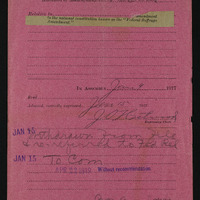
In addition to granting women the right to vote, the 1911 women’s suffrage amendment also paved the way for women to hold political office in California. In 1918, Esto B. Broughton, Elizabeth Hughes, Anna L. Saylor, and Grace S. Dorris became the first four women elected to the California State Assembly. Though fifteen states had already granted women full voting rights, a federal amendment was required to secure nationwide suffrage. To push for this national change, two almost identical resolutions were introduced on January 9, 1919 to urge the U.S. Congress to move forward with “the amendment to the National Constitution known as ‘The Federal Suffrage Amendment.’". On just her third day in office, newly elected Assemblywoman Grace S. Dorris introduced Assembly Joint Resolution No. 1. Simultaneously, Senate Joint Resolution No. 3 was introduced by Senator Burnett, a male colleague in the State Senate. While Dorris's historic Assembly bill ultimately died in committee, its twin Senate resolution successfully advanced, passing both chambers on January 17, 1919.
Date: January 1919