
Search All Items
- Filters:
- Language
- English 6457
- Spanish 23
- ENGLISH 2
- English 2
- census_013 1
- contra_costa_schedule_1_volume_1 1
- Type
- Image 3882
- Still Image 2094
- Text 445
- Text 54
- Textual 2
- Image of the California Census from the records of the office of the California Secretary of State 1
Search Results 6531 to 6540 of 6559
-
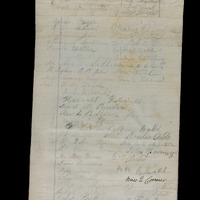
Ahead of the second California Constitutional Convention held in Sacramento from September 28, 1878 to March 3, 1879, petitions were circulated around California in support of amending Article II of the 1849 constitution. The petitions included over 2,500 signatures and asserted that “no citizen of the State shall be disenfranchised on the account of sex.” The petition shown here from October 10, 1878 contains hundreds of signatures and measures over seven feet long. However, the many signatures indicating support for the amendment were not enough to sway the all-male delegation at the 1878-1879 Constitutional Convention. Several delegates expressed fears about the impact of enfranchising women as well as concerns that the inclusion of women’s suffrage in the new 1879 constitution would threaten its ratification. After several days of debate, the amendment did not move forward.
Date: October 10, 1878
-
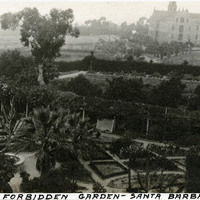
Caption: "Forbidden Garden -- Santa Barbara Mission," c. 1910. View of the gardens associated with Santa Barbara Mission. The gardens initially served as the location for instructing neophytes (Native American converts living at the mission) in trades and skills deemed necessary to life in European civilization. Later, the garden was used for meditation. The garden was often dubbed "forbidden" because it was closed to female visitors, as were many enclosures in active missions.
Date: 1910
-
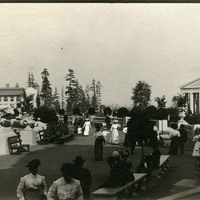
No Caption: View of a portion of the fairgrounds of the Alaska-Yukon-Pacific Exposition in Seattle, showing elegantly attired fairgoers strolling pathways and resting on benches. Held in Seattle to celebrate the development of the Pacific Northwest, the fair attracted 3.7 million visitors over the course of its run from June to October 1909. Although most of the fair's buildings have since been destroyed, several of them now serve as part of the University of Washington campus.
Date: 1909
-
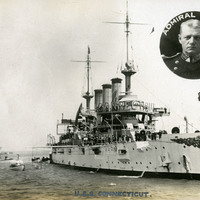
Caption: "USS Connecticut, Admiral Evans," c. 1908. View of the USS Connecticut, with an inset circular photograph of Admiral Evans. The USS Connecticut was commissioned on September 29, 1906 as the most advanced ship in the U.S. Navy. Because the provisions of the Washington Naval Treaty of 1922 stipulated that older battleships would be disposed of, the Connecticut was decommissioned and sold for scrap in 1923.
Date: 1908
-
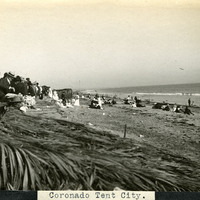
Caption: "Coronado Tent City.," c. 1910. Beach scene near the Coronado Hotel, showing groups of people enjoying a day at the sea shore. Established in 1900 for travelers who could not afford to stay in the resort hotel, the Coronado Tent City consisted of a grid of streets lined with furnished tents, near the sea shore. It also featured restaurants, a library, soda fountain, theater, bandstand, and other recreational facilities.
Date: 1910
-
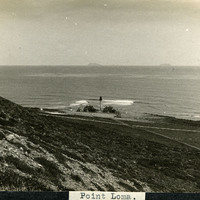
Caption: "Point Loma.," c. 1905. View of Point Loma and the so-called "New Point Loma Lighthouse" in the center. The lighthouse, first lit in 1891, replaced the "Old Point Loma Lighthouse" that had been constructed in 1855. The old lighthouse was often obscured by fog, so a new lighthouse was built at a much lower elevation much closer to sea level. The light was automated in 1973.
Date: 1905
-
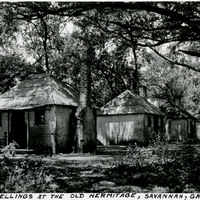
Caption: "Slave Dwellings at the Old Hermitage, Savannah, Ga. July 15, 1934." A row of small brick houses surrounded by trees. The Old Hermitage was a 400-acre plantation on the Savannah River, owned by Henry McAlpin. McAlpin not only conducted farming operations at the plantation, but also manufactured bricks, barrels, cast iron products, and lumber. For that reason, he built the slave quarters for the plantation from brick, rather than wood as was common for most other plantations in the South.
Date: 7/15/1934
-
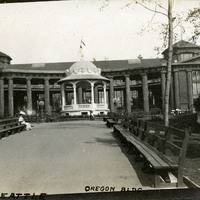
Caption: "A.Y.P.E. Seattle Oregon Bldg." View of Oregon Building and bandstand, part of the Alaska-Yukon-Pacific Exposition. Held in Seattle to celebrate the development of the Pacific Northwest, the fair attracted 3.7 million visitors over the course of its run from June to October 1909. Although most of the fair's buildings have since been destroyed, several of them now serve as part of the University of Washington campus.
Date: 1909
-
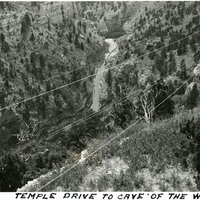
Caption: "Temple Drive to Cave of the Winds," c. 1923. Bird's eye view of a road at the bottom of a canyon, on a drive to Cave of the Winds. Two brothers discovered the entrance to the large cave system in 1880, in Williams Canyon just outside of Manitou Springs. Further exploration resulted in opening more caverns within the system, and the site became a tourist attraction, with guided tours having been on offer since 1881.
Date: 1923
-
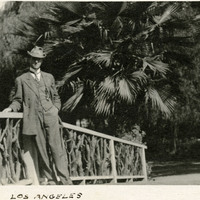
Caption: "Echo Park [sic] Los Angeles," c. 1906. Unidentified man leaning on a railing made of tree branches, with palm trees and other vegetation in the background. Echo Lake Park opened in 1895. The lake was originally created in 1868 to support the operations of a mill. The mill, however, closed seven years later. The site was later selected for conversion to a city park.
Date: 1906