
Search All Items
- Filters:
- Type
- Image 3882
- Still Image 2127
- Text 433
- Text 50
- Image of the California Census from the records of the office of the California Secretary of State 1
- Language
- English 6465
- Spanish 33
- ENGLISH 2
- English 2
- census_013 1
- contra_costa_schedule_1_volume_1 1
Search Results 6551 to 6560 of 6569
-
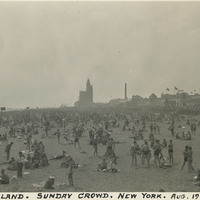
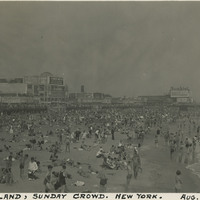
Caption: "Coney Island. Sunday Crowd. New York. Aug. 19, 1934." Very crowded beach scene on New York's Coney Island. The construction of several resort hotels on the island in the 1870s and 1880s encouraged construction of amusement parks to provide tourist destinations. Coney Island has hosted several large amusement parks over the years, including one of the world's first roller coasters (built in 1884). Numerous smaller attractions were available as well. The island's popularity peaked in the mid-twentieth century, in the World War II era, but despite some decline is still a world-renowned recreation area.
Date: 8/19/1934
-
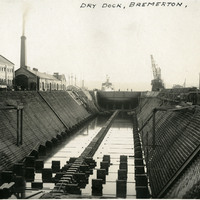
Caption: "Dry Dock, Bremerton." Bremerton, Washington, c. 1908-1912. See also 96-07-08-alb08-085. View of a dry dock at the Puget Sound Naval Shipyard in Bremerton, Washington. Established in 1891 as a naval station, it became Naval Yard Puget Sound in 1901. During World War I the shipyard constructed hundreds of ships to support the war effort, while in World War II, the shipyard was dedicated primarily to repairing damaged ships. Today, it contains a portion of the U.S. Navy's mothball fleet (ships retired but retained in case of future need), as well as building, repairing, and maintaining sea-going vessels of all kinds.
Date: 1908
-
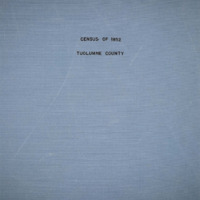
The Census of 1852 collection includes enumerations of California's 32 counties, arranged into 126 volumes. Schedule I enumerated the county's inhabitants, while schedule II enurmerated economic production. Many pages of this volume are damaged.
Date: 1852
-
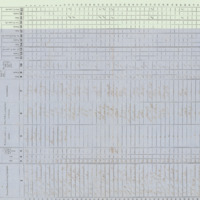
The Census of 1852 collection includes enumerations of California's 32 counties, arranged into 126 volumes. Schedule I enumerated the county's inhabitants, while schedule II enurmerated economic production. Many pages of this volume are damaged.
Date: 1852
-
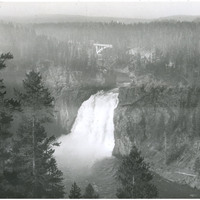
No caption. c. 1923. As the Yellowstone River flows north from Yellowstone Lake it passes over two waterfalls (Upper and Lower Yellowstone Falls) before reaching the Yellowstone Grand Canyon. This photograph shows the Upper Yellowstone Falls, 109 feet in height, as seen from a nearby peak. One arch of the Chittenden Bridge can be seen crossing the Yellowstone River upstream of the falls (in the upper center of the photograph). Built in 1903, this Melan arch bridge stood until the 1960s, when it was torn down in favor of a new, more modern structure.
Date: 1923
-
Caption: "Coney Island, Sunday Crowd. New York. Aug. 19, 1934." Very crowded beach scene on New York's Coney Island. The construction of several resort hotels on the island in the 1870s and 1880s encouraged construction of amusement parks to provide tourist destinations. Coney Island has hosted several large amusement parks over the years, including one of the world's first roller coasters (built in 1884). Numerous smaller attractions were available as well. The island's popularity peaked in the World War II era, but despite some decline is still a world-renowned recreation area.
Date: 8/19/1934
-
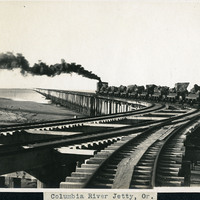
Caption: "Columbia River Jetty, Or.," c. 1910. View of a jetty built at the mouth of the Columbia River, carrying a railroad trestle. A train hauling cars loaded with large rocks is steaming away from the photographer. This is likely the so-called South Jetty, extending more than six miles into the ocean from Point Adams on the Oregon side of the river mouth. The jetty system at the mouth of the Columbia River was constructed between 1885 and 1917. Designed to funnel water from the Columbia River in a more concentrated fashion into the Pacific Ocean, the jetty system helped create a deeper, more stable shipping channel.
Date: 1910
-
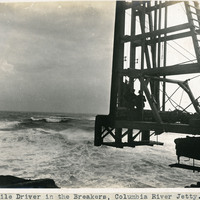
Caption: "Pile Driver in the Breakers, Columbia River Jetty.," c. 1910. View of a large pile driver used in the construction of the jetty system at the mouth of the Columbia River. This is likely at the end of the so-called South Jetty, extending more than six miles into the ocean from Point Adams on the Oregon side of the river mouth. The jetty system at the mouth of the Columbia River was constructed between 1885 and 1917. Designed to funnel water from the Columbia River in a more concentrated fashion into the Pacific Ocean, the jetty system helped create a deeper, more stable shipping channel.
Date: 1910
-
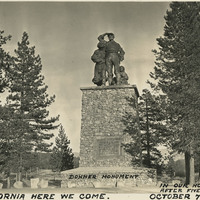
Caption: "California Here We Come. Donner Monument. In Our Home State Again After Five Months Tour. October 7, 1934." William and Grace McCarthy took this photograph of the Pioneer Monument when they arrived back in California after a five month road trip to the East Coast. The Pioneer Monument, featuring a pair of pioneers with their two children looking west, was first dedicated on June 6, 1918 to commemorate those who emigrated to California in the mid 1800s. Today, the monument and surrounding area is known as Donner Memorial State Park. The park was established in memory of the ill-fated Donner Party, a group of emigrants whose wagon train was caught in the Sierra Nevada Mountains during the winter of 1846-47. The Pioneer Monument's stone pedestal stands twenty-two feet high, the height of the snow that the party had to contend with. Of the eighty-seven people in the wagon train, only forty-eight survived to be rescued the following spring. Some of the survivors are said to have resorted to cannibalism in order to survive.
Date: 10/7/1934
-
The Census of 1852 collection includes enumerations of California's 32 counties, arranged into 126 volumes. Schedule I enumerated the county's inhabitants, while schedule II enurmerated economic production. Many pages of this volume are damaged.
Date: 1852