
Search All Items
- Filters:
- Type
- Image 3888
- Still Image 2857
- Text 431
- Text 50
- Image of the California Census from the records of the office of the California Secretary of State 1
- Language
- English 7190
- Spanish 43
- ENGLISH 3
- English 2
- census_013 1
- contra_costa_schedule_1_volume_1 1
Search Results 6711 to 6720 of 7317
-
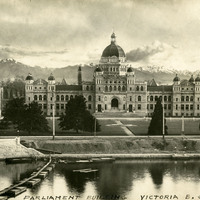
Caption: " Parliament Building Victoria B.C." c. 1909. Constructed in the Neo-baroque, Renaissance Revival and Romanesque Revival architectural style (Francis Rattenbury, architect), the British Columbia Parliament Buildings were completed in 1897, and are home to the Legislative Assembly of British Columbia.
Date: 1909
-
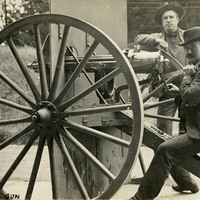
Caption: "Gatling Gun," c. 1905. William McCarthy sitting in the operator's position of a Gatling gun, an early rapid-fire, crank-turned weapon first used during combat in the Civil War. Developed in 1861 by Dr. Richard J. Gatling, the weapon was commonly used during the late nineteenth century before being superseded by newer, more modern guns.
Date: 1905
-
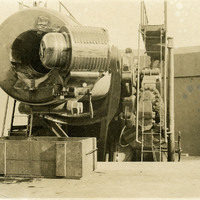
No caption, c. 1915. Twelve-inch disappearing coastal defense gun, showing the breech of the barrel where shells are loaded and ejected. Retracting or disappearing guns were a form of artillery developed in the nineteenth century in which heavy artillery guns were placed on rotating carriages that allowed retraction of the weapon after firing, to enable reloading while under enemy fire.
Date: 1915
-
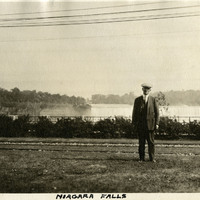
Caption: "Niagara Falls, c. 1925. William McCarthy poses in front of American Falls and Bridal Veil Falls, two of the three waterfalls that make up the iconic Niagara Falls straddling the border between Ontario, Canada, and the State of New York.
Date: 1925
-
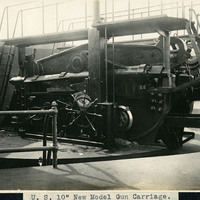
Caption: "U. S. 10" New Model Gun Carriage.," c. 1908-1912. Side view of a coastal defense disappearing gun carriage, without the gun barrel installed. Retracting or disappearing guns were a form of artillery developed in the nineteenth century in which heavy artillery guns were placed on rotating carriages that allowed retraction of the weapon after firing, to enable reloading while under enemy fire.
Date: 1908
-
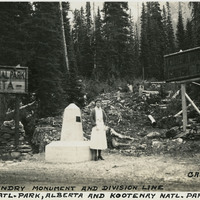
Caption: "Boundary monument and division line. Banff Natl. Park, Alberta, and Kootenay Natl. Park, B.C., Canada," c. 1935, shows Grace McCarthy standing by the monument and dividing line between the national parks in Alberta and British Columbia.
Date: 1935
-
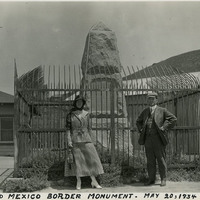
Caption: "U. S. and Mexico Border Monument. May 20, 1934." William and Grace McCarthy standing in front of the monument placed at the U.S.-Mexico border in Tijuana, Mexico.
Date: 5/20/1934
-
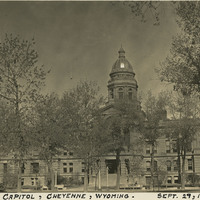
Caption: "State Capitol, Cheyenne, Wyoming. Sept. 29, 1934". Wyoming's State Capitol Building in Cheyenne was built between 1886 and 1890. Designed by the architectural firm David W. Gibbs & Company, the building features Renaissance Revival styling and elements.
Date: 9/29/1934
-
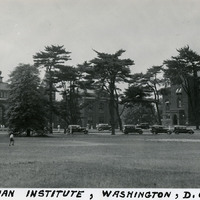
Caption: "Old Smithsonian Institute, Washington, D.C. July 28, 1934." Taken from across a park, this photograph shows the Smithsonian complex rising above surrounding trees. Built in 1855, it houses the Smithsonian Institute's administrative offices and information center.
Date: 7/28/1934
-
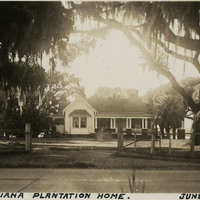
Caption: "A Louisiana Plantation Home. June 13, 34." A single-story residence featuring a long porch with paired columns, set back from the road. Picturesque trees dripping with Spanish moss bracket the home.
Date: 6/13/1934