
Search All Items
- Filters:
- Language
- English 6853
- Spanish 18
- ENGLISH 3
- English 2
- census_013 1
- contra_costa_schedule_1_volume_1 1
- Type
- Image 3886
- Still Image 2484
- Text 441
- Text 54
- Textual 2
- Image of the California Census from the records of the office of the California Secretary of State 1
Search Results 6731 to 6740 of 6969
-
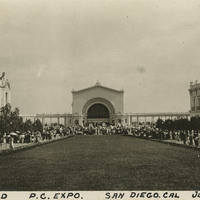
Caption: "Music Stand PC. Expo. San Diego, Cal. July 18, 1915," at the Panama-California Exposition in Balboa Park, San Diego.
Date: 1915
-
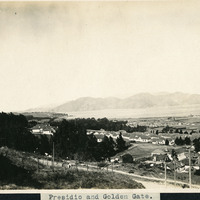
Caption: "Presidio and Golden Gate.," c. 1906. A birds eye view of the Presidio at San Francisco, California, c. 1906. See also 96-07-08-alb02-024.
Date: 1906
-
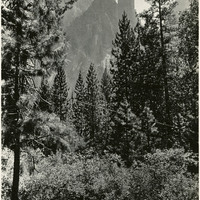
Caption: "Cathedral Spires," c. 1917. Rock formation known as Cathedral Spires in Yosemite National Park, as seen from the valley floor through trees.
Date: 1917
-
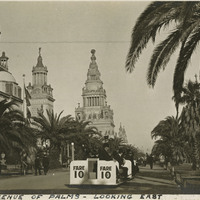
Caption: "Avenue of Palms - Looking East," with Fageol car, at the Panama-Pacific International Exposition. See also 96-07-08-alb03-041.
Date: 1915
-
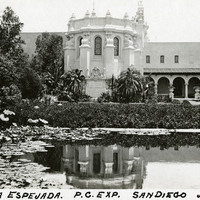
Caption: "La Laguna Espejada. P.C. EXP. San Diego July 18, 1915." A view of a reflecting pool at the Panama-California Exposition in San Diego.
Date: 1915
-
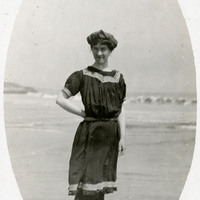
No caption, c. 1906. Grace McCarthy in swim suit on beach, with surf around her feet and waves in the background.
Date: 1906
-
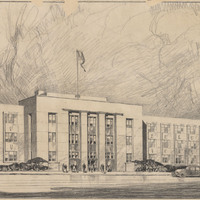
Pencil drawing by Alfred Eichler of office building for the Division of Highways, Los Angeles. Project for Department of Public Works - Highways - District VII - Los Angeles.
Date: 1941
-
Caption: "Stockton Acute Dist." Design and drawing of Acute Disturbed Ward, Stockton State Hospital, by Alfred Eichler. Built. Project for Department of Mental Hygiene - Hospitals.
Date: 1937
-
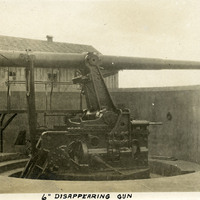
Caption: "6" Disappearing Gun," c. 1915. Side view of a 6" disappearing gun in a barbette (gun emplacement). Retracting or disappearing guns were a form of artillery developed in the nineteenth century in which heavy artillery guns were placed on rotating carriages that allowed retraction of the weapon after firing, to enable reloading while under enemy fire.
Date: 1915
-
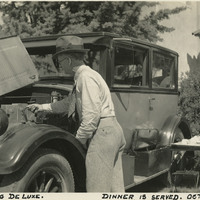
Caption: "Touring De Luxe. Dinner is Served. Oct. 10, 1934." William McCarthy is cooking a meal in metal boxes on the engine of his Studebaker sedan, while Grace McCarthy is seated to the right at a small folding table awaiting dinner.
Date: 10/10/1934