
Search All Items
Search Results 671 to 680 of 6229
-
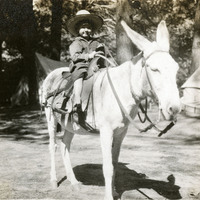
No caption, c. 1935. Small child riding a donkey in campground at Yosemite National Park.
Date: 1935
-
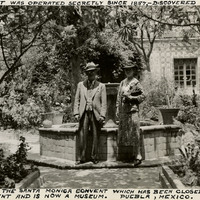
Caption: "This convent was operated secretly since 1857, - discovered in 1935. Garden in the Santa Monica convent which has been closed by the government and is now a museum. Puebla, Mexico." William and Grace McCarthy standing by a fountain in the garden described above.
Date: 1938
-
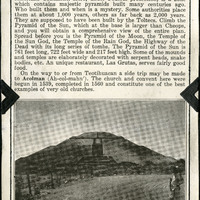
No Caption: A section from an informational tourist brochure describing Teotihuacan, an area northeast of Mexico City and famous for some of the most important archaeological discoveries on the North American Continent.
Date: 1938
-
Caption: "Hialeah Race Track -- Miami -- Florida July 1, 1934." Grace McCarthy standing behind the grandstand at Hialeah Park Race Track, in Hialeah (near Miami). Constructed in 1922 as a greyhound racetrack, Hialeah began hosting horse races in 1925. Joseph E. Widener purchased the track in 1930. He embarked upon a series of improvements, adding a grandstand (seen here) and clubhouse facilities designed by Lester W. Geisler, as well as landscaped gardens and a lake in the infield that became home to a flock of flamingos. The new and improved Hialeah track, now called Hialeah Park, officially opened in 1932.
Date: 7/1/1934
-
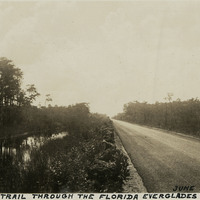
Caption: "Tamiami Trail Through the Florida Everglades, June 27, 1934." Asphalt-paved road stretching into the distance, flanked on one side by a canal. The Tamiami Trail constitutes a scenic portion of what is now U.S. Highway 41. Work on a road connecting Tampa with Miami began in 1915, but the Trail was not officially opened until 1928. Work on the route required building across a portion of the massive swamp system of the Everglades. Workers dredged and blasted a canal along the route, and used the fill dirt thus removed to construct the roadway proper.
Date: 6/27/1934
-
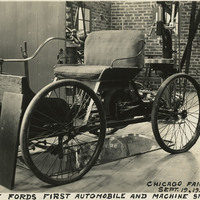
Caption: "Henry Ford's First Automobile and Machine Shop, Chicago Fair Exhibit. Sept. 19, 1934." This exhibit within the Ford Building at Chicago's Century of Progress Exposition replicated Henry Ford's original workshop, including a Quadricycle, the first automobile produced by Ford. The Exposition, a world fair attended by thirty-nine million people, celebrated Chicago's one-hundred year anniversary of incorporation. Originally planned to only run from May to November in 1933, it was such a success that its organizers decided to keep it running for a second season from May through October the following year. The central theme of the Exposition was technological innovation, with a motto of "Science Finds, Industry Applies, Man Conforms."
Date: 9/19/1934
-
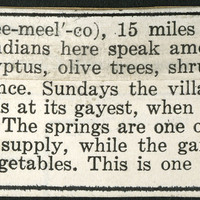
No Caption: A section from an informational tourist brochure describing Xochimilco, south of Mexico City, sometimes called the Mexican Venice, for its canals and floating gardens.
Date: 1938
-
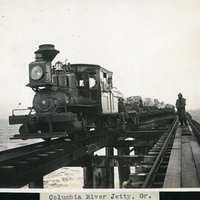
Caption: "Columbia River Jetty, Or.," c. 1910. View of a jetty built at the mouth of the Columbia River, carrying a railroad trestle. A train and its operators, hauling cars loaded with large rocks, dominates the photograph. This is likely the so-called South Jetty, extending more than six miles into the ocean from Point Adams on the Oregon side of the river mouth. The jetty system at the mouth of the Columbia River was constructed between 1885 and 1917. Designed to funnel water from the Columbia River in a more concentrated fashion into the Pacific Ocean, the jetty system helped create a deeper, more stable shipping channel.
Date: 1910
-
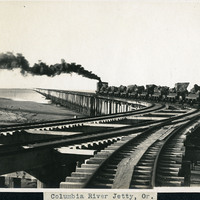
Caption: "Columbia River Jetty, Or.," c. 1910. View of a jetty built at the mouth of the Columbia River, carrying a railroad trestle. A train hauling cars loaded with large rocks is steaming away from the photographer. This is likely the so-called South Jetty, extending more than six miles into the ocean from Point Adams on the Oregon side of the river mouth. The jetty system at the mouth of the Columbia River was constructed between 1885 and 1917. Designed to funnel water from the Columbia River in a more concentrated fashion into the Pacific Ocean, the jetty system helped create a deeper, more stable shipping channel.
Date: 1910
-
No caption, c. 1920. Shows large unidentified building with terraced gardens and a flag pole.
Date: 1920