
Search All Items
- Filters:
- Type
- Image 3888
- Still Image 2857
- Text 431
- Text 50
- Image of the California Census from the records of the office of the California Secretary of State 1
- Language
- English 7190
- Spanish 43
- ENGLISH 3
- English 2
- census_013 1
- contra_costa_schedule_1_volume_1 1
Search Results 7191 to 7200 of 7317
-
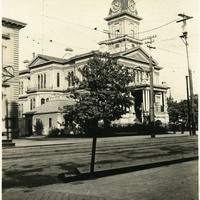
Caption: "Oakland City Hall," Oakland, California, c. 1910. Completed in 1879, the building was Oakland's second city hall and served until it was demolished in 1914 to create City Hall Plaza in front of the new City Hall that had been completed that year.
Date: 1910
-
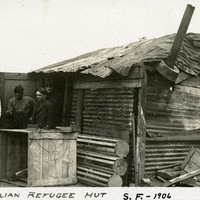
Caption: "Italian Refugee Hut S.F. -- 1906." Makeshift hut with four unidentified men standing in doorway. After the earthquake and fire that destroyed much of San Francisco in April 1906, hundreds of thousands of people were left homeless. Many of these people established temporary refugee camps, using debris from the destruction to cobble together shelters.
Date: 1906
-
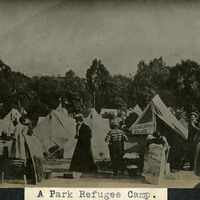
Caption: "A Park Refugee Camp," c. 1906. After the earthquake and fire that destroyed much of San Francisco in April 1906, hundreds of thousands of people were left homeless. Many of these people established temporary refugee camps, using tents or debris from the destruction to cobble together shelters.
Date: 1906
-
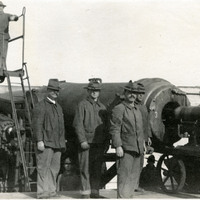
No Caption: c. 1908-1912. Group of men posing around a 12-inch disappearing gun. Retracting or disappearing guns were a form of artillery developed in the nineteenth century in which heavy artillery guns were placed on rotating carriages that allowed retraction of the weapon after firing, to enable reloading while under enemy fire. Such guns were often used in coastal fortifications.
Date: 1908
-
Caption: "Tomb of President Gomez, Havana. July 4th 1934." José Miguel Gómez y Gómez was instrumental in the Cuban War of Independence (1895-1898), and also served as Cuba's President from 1909-1913. Although he died in New York, his remains were interred in the Colon Cemetery in Havana.
Date: 7/4/1934
-
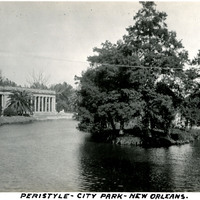
Caption: "Peristyle - City Park- New Orleans," c. 1925. The Neoclassical open air pavilion seen at the left side of this photograph was built in New Orleans' City Park in 1907 to host parties, dances and weddings. It was designed by architect Paul Andry.
Date: 1925
-
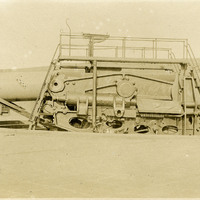
No Caption: c. 1908-1912. Side view of a disappearing coastal artillery gun. Retracting or disappearing guns were a form of artillery developed in the nineteenth century in which heavy artillery guns were placed on rotating carriages that allowed retraction of the weapon after firing, to enable reloading while under enemy fire.
Date: 1908
-
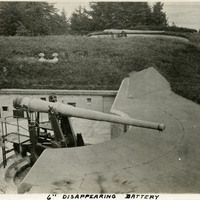
Caption: "6" Disappearing Battery," c. 1905-1909. A 6" disappearing gun in a barbette (gun emplacement). Retracting or disappearing guns were a form of artillery developed in the nineteenth century in which heavy artillery guns were placed on rotating carriages that allowed retraction of the weapon after firing, to enable reloading while under enemy fire.
Date: 1905
-
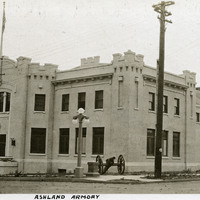
Caption: "Ashland Armory," c. 1915-1920. View of the National Guard Armory built in Ashland, Oregon. Designed by Oregon's first State Architect William C. Knighton, the armory has also been used as a community hall since its construction in 1912-1913.
Date: 1915
-
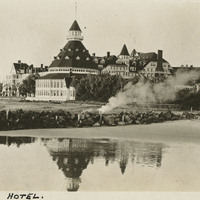
Caption: "Coronado Hotel," c. 1915, shows the luxury seaside resort in San Diego County, founded by Elisha Babcock and H.L. Story, and built in 1888. The hotel was designated a California Historical Landmark in 1970, and a National Historic Landmark in 1977. See also 96-07-08-alb01-150.
Date: 1915