
Search All Items
- Filters:
- Language
- English 7210
- Spanish 43
- ENGLISH 3
- English 2
- census_013 1
- contra_costa_schedule_1_volume_1 1
- Type
- Image 3888
- Still Image 2860
- Text 445
- Text 54
- Textual 2
- Image of the California Census from the records of the office of the California Secretary of State 1
Search Results 7211 to 7220 of 7358
-
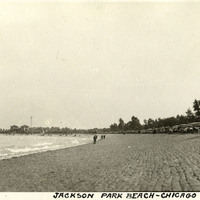
Caption: "Jackson Park Beach - Chicago," c. 1923. Jackson Park Beach at Lake Michigan, with a line of automobiles parked along the adjacent roadway.
Date: 1923
-
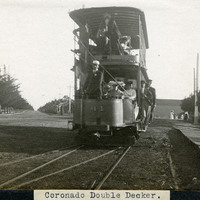
Caption: "Coronado Double Decker.," c. 1905. View of Car #41, a two-level trolley car operated by the San Diego Electric Railway in Coronado.
Date: 1905
-
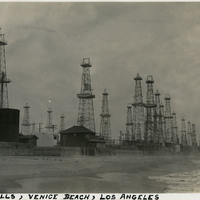
Caption: "Oil Wells, Venice Beach, Los Angeles," c. 1935, shows numerous oil wells along the shoreline of Venice Beach in Los Angeles.
Date: 1935
-
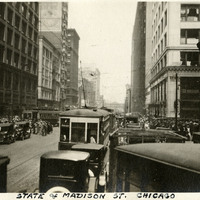
Caption: "State & Madison St. Chicago," c. 1923. A busy street scene at the intersection of State and Madison Streets in Chicago.
Date: 1923
-
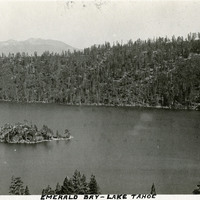
Caption: "Emerald Bay -- Lake Tahoe." Features Fannette Island, a small island in the middle of Emerald Bay, on southwestern edge of Lake Tahoe.
Date: 1927
-
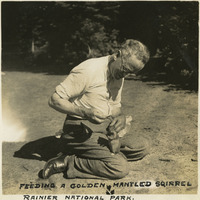
Caption: "Feeding a Golden Mantled Squirrel Rainier National Park," c. 1935, shows William McCarthy feeding the wildlife at Mt. Rainier National Park.
Date: 1935
-
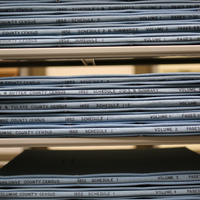
Digital photograph of 12 volumes of the Census of 1852 from Solano, Sonoma, Sutter, Trinity, Tulare, and Tuolumne Counties shelved in California State Archives collections stacks.
Date: 2017
-
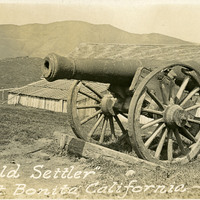
No Caption: Inscribed on the photograph: "An "Old Settler" Pt. Bonita, California." A view of a large cannon on a carriage.
Date: Undated
-
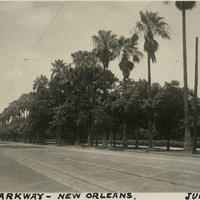
Caption: "City Parkway -- New Orleans. June 16, 34." A row of palm trees interspersed with deciduous trees runs down the middle of this road in New Orleans.
Date: 6/16/1934
-
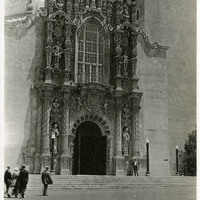
Caption: "Panama-California Exposition, San Diego," shows a view of an elaborately decorated building at the Panama-California Exposition in San Diego.
Date: 1915