Search All Items
Search Results 711 to 720 of 5331
-
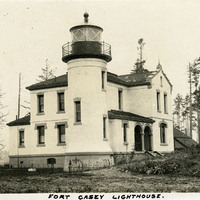
Caption: "Machinists' Headquarters, Fort Casey.," c. 1908-1912. View of building with gabled roof and sides sheathed in wood planks, with a small shed to the left and another small building to the right. Fort Casey was part of the "triangle of fire," three coastal defense fortifications (Fort Casey, Fort Worden, and Fort Flagler) guarding the entrance to Puget Sound. Construction began on the fort in 1897, and the U.S. Army used the facility until the 1950s, when the fort was decommissioned. The area is now a state park.
Date: 1908
-
Caption: "Chief Manitou of Taos N. M. - Manitou Soda Springs," c. 1923. Grace McCarthy, wearing a Native American headdress and beaded blanket, stands next to a smiling Pedro Cajete in traditional dress. Mr. Cajete, better known to many as Chief Manitou, was a Native American of the Tewa tribe near Santa Fe, New Mexico, who was hired to promote tourism in the Manitou Springs/Colorado Springs area of Colorado. He often sold trinkets and posed for photographs with tourists near the mouth of Manitou Cave, resulting in his moniker Chief Manitou.
Date: 1923
-
Caption: "Old Landmark, Seaside, Or.," c. 1910. Shows a picket fence erected around what a sign calls "Remains of Cairn where Lewis & Clark made salt from the ocean water Jan. & Feb. 1806." When the famous expedition led by Merriweather Lewis and William Clark reached the Pacific Ocean in late 1805, their supplies had run dangerously low, including their salt supply. Salt, used not only to flavor meat but also to preserve it, was extremely important to the health of the expedition. Three of Lewis and Clark's men traveled to a site on the coast near present-day Seaside, Oregon to set up a small salt-works, boiling ocean water in a series of large kettles and then scraping the resulting salt crust off of the sides. In this manner, the men eventually collected about twenty gallons of salt before Lewis and Clark decided the supply was sufficient for the return journey. In 1910, the property containing the remains of the cairns was deeded to the Oregon Historical Society. In 1955, replica salt cairns were built at the site by the Lions Club to commemorate the expedition's activities.
Date: 1910
-
Caption: "Garden at American Radiator Co. Exhibit. Chicago [sic] Fair. Sept. 18, 1934." William McCarthy stands in front of a series of pools cascading into one another, surrounded by manicured plants at the Century of Progress Exposition. The Exposition, a world fair attended by thirty-nine million people, celebrated Chicago's one-hundred year anniversary of incorporation. Originally planned to only run from May to November in 1933, it was such a success that its organizers decided to keep it running for a second season from May through October the following year. The central theme of the Exposition was technological innovation, with a motto of "Science Finds, Industry Applies, Man Conforms."
Date: 9/18/1934
-
Caption: "Ocean Park," c. 1910. Night view of amusement zone at what became Venice, California. In 1905, Abbot Kinney built a series of canals as part of a development project along Santa Monica Beach, hoping to recreate the look and feel of Italy's iconic "Floating City" in southern California. Called Ocean Park at first, in 1911, the name officially changed to Venice. By 1929, however, many of the canals had been filled in to create roadways, and those that remained fell into disrepair. A revitalization movement in the early 1990s has restored some of the canals, and made the area a desirable residential neighborhood.
Date: 1910
-
Caption: "Fort Winfield Scott Target Practice." This postcard shows a plume of seawater thrown up by a mortar shell during target practice at Fort Point. Fort Point was part of an effort by the U.S. government to protect the Golden Gate, entrance to the San Francisco Bay. Built between 1853-1861, the fort included emplacements for 141 guns but never fired a weapon in defense of the Bay. Its name was officially changed in 1882 to Fort Winfield Scott. This only lasted four years, however, for in 1886 the fort was officially downgraded to a sub-post of the San Francisco Presidio and the name discontinued. It was resurrected in 1912, with the establishment of a coastal artillery fortification at the Presidio, called, once again, Fort Winfield Scott. See also 96-07-08-alb08-029.
Date: 1909-10-25
-
Caption: "Jones's [sic] Beach Tower, New York. Aug. 26 1934." The large tower in the center of this photograph was a 188-foot-tall water tower in Jones Beach, built in 1930 in imitation of the Italianate-style bell tower of St. Mark's Basilica in Venice, Italy. The Long Island State Park Commission began to develop what is now the Jones Beach area for a park in the 1920s, dredging enough sand to connect several of the barrier islands south of Long Island and raising the elevation of the islands by fourteen feet to create one large park. It opened to the public in 1929. It is now a state park, with an estimated six million visitors each year.
Date: 8/26/1934
-
Caption: "Portion of Interior. Fort Point.," c. 1906. View of arched colonnades on ground and middle floors of Fort Point, and an upper tier with barbettes for the future installation of heavy artillery coastal defense weapons. The facilities at Fort Point were part of an effort by the U.S. government to protect the Golden Gate, entrance to the San Francisco Bay. Built between 1853-1861, the fort included emplacements for 141 guns but never fired a weapon in defense of the Bay. Its name was officially changed in 1882 to Fort Winfield Scott, but in 1886 the fort was officially downgraded to a sub-post of the San Francisco Presidio and the name discontinued. It was resurrected in 1912, with the establishment of a coastal artillery fortification at the Presidio, called, once again, Fort Winfield Scott.
Date: 1906
-
Caption: "Crowd Watching Chrysler Automobile Maneuvers. Chicago Fair. Sept. 17, 1934." Fairgoers pack the stands at a demonstration of the capabilities of Chrysler automobiles on a track created as part of the Chrysler complex built for the Exposition. The Exposition, a world fair attended by thirty-nine million people, celebrated Chicago's one-hundred year anniversary of incorporation. Originally planned to only run from May to November in 1933, it was such a success that its organizers decided to keep it running for a second season from May through October the following year. The central theme of the Exposition was technological innovation, with a motto of "Science Finds, Industry Applies, Man Conforms."
Date: 9/17/1934
-
Caption: "The Lagoon with the Sky Ride in the distance. Chicago Fair. Sept. 18, 1934." Dominating this photograph is one of the 628-foot towers making up the Sky Ride, an aerial tramway which carried fair goers in small gondolas or trams (visible just to the left of the tower) over the harbor around which the Century of Progress Exposition was held. Over 4.5 million passengers enjoyed the views from the Sky Ride before it was demolished after the conclusion of the exposition in 1934. The Exposition, a world fair attended by thirty-nine million people, celebrated Chicago's one-hundred year anniversary of incorporation. Originally planned to only run from May to November in 1933, it was such a success that its organizers decided to keep it running for a second season from May through October the following year. The central theme of the Exposition was technological innovation, with a motto of "Science Finds, Industry Applies, Man Conforms."
Date: 9/18/1934