
Search All Items
Search Results 731 to 740 of 5365
-
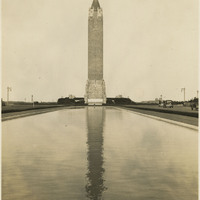
Caption: "Jones's [sic] Beach Tower, New York. Aug. 26 1934." The large tower in the center of this photograph was a 188-foot-tall water tower in Jones Beach, built in 1930 in imitation of the Italianate-style bell tower of St. Mark's Basilica in Venice, Italy. The Long Island State Park Commission began to develop what is now the Jones Beach area for a park in the 1920s, dredging enough sand to connect several of the barrier islands south of Long Island and raising the elevation of the islands by fourteen feet to create one large park. It opened to the public in 1929. It is now a state park, with an estimated six million visitors each year.
Date: 8/26/1934
-
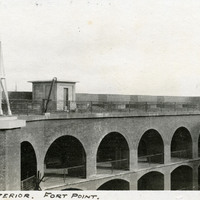
Caption: "Portion of Interior. Fort Point.," c. 1906. View of arched colonnades on ground and middle floors of Fort Point, and an upper tier with barbettes for the future installation of heavy artillery coastal defense weapons. The facilities at Fort Point were part of an effort by the U.S. government to protect the Golden Gate, entrance to the San Francisco Bay. Built between 1853-1861, the fort included emplacements for 141 guns but never fired a weapon in defense of the Bay. Its name was officially changed in 1882 to Fort Winfield Scott, but in 1886 the fort was officially downgraded to a sub-post of the San Francisco Presidio and the name discontinued. It was resurrected in 1912, with the establishment of a coastal artillery fortification at the Presidio, called, once again, Fort Winfield Scott.
Date: 1906
-
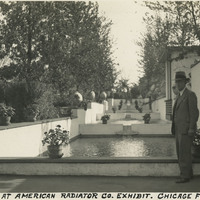
Caption: "Garden at American Radiator Co. Exhibit. Chicago [sic] Fair. Sept. 18, 1934." William McCarthy stands in front of a series of pools cascading into one another, surrounded by manicured plants at the Century of Progress Exposition. The Exposition, a world fair attended by thirty-nine million people, celebrated Chicago's one-hundred year anniversary of incorporation. Originally planned to only run from May to November in 1933, it was such a success that its organizers decided to keep it running for a second season from May through October the following year. The central theme of the Exposition was technological innovation, with a motto of "Science Finds, Industry Applies, Man Conforms."
Date: 9/18/1934
-
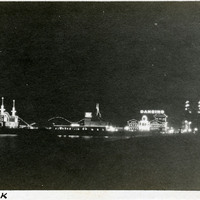
Caption: "Ocean Park," c. 1910. Night view of amusement zone at what became Venice, California. In 1905, Abbot Kinney built a series of canals as part of a development project along Santa Monica Beach, hoping to recreate the look and feel of Italy's iconic "Floating City" in southern California. Called Ocean Park at first, in 1911, the name officially changed to Venice. By 1929, however, many of the canals had been filled in to create roadways, and those that remained fell into disrepair. A revitalization movement in the early 1990s has restored some of the canals, and made the area a desirable residential neighborhood.
Date: 1910
-
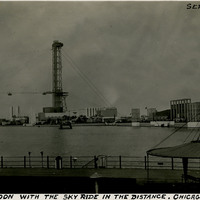
Caption: "The Lagoon with the Sky Ride in the distance. Chicago Fair. Sept. 18, 1934." Dominating this photograph is one of the 628-foot towers making up the Sky Ride, an aerial tramway which carried fair goers in small gondolas or trams (visible just to the left of the tower) over the harbor around which the Century of Progress Exposition was held. Over 4.5 million passengers enjoyed the views from the Sky Ride before it was demolished after the conclusion of the exposition in 1934. The Exposition, a world fair attended by thirty-nine million people, celebrated Chicago's one-hundred year anniversary of incorporation. Originally planned to only run from May to November in 1933, it was such a success that its organizers decided to keep it running for a second season from May through October the following year. The central theme of the Exposition was technological innovation, with a motto of "Science Finds, Industry Applies, Man Conforms."
Date: 9/18/1934
-
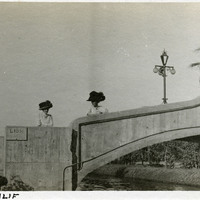
Caption: "Venice, Calif," c. 1911. Grace McCarthy and an unidentified woman standing on a bridge over Lion Canal in Venice, California. In 1905, Abbot Kinney built a series of canals as part of a development project along Santa Monica Beach, hoping to recreate the look and feel of Italy's iconic "Floating City" in southern California. Called Ocean Park at first, gondoliers sailed boats under elegant bridges such as the one shown in this photograph, in an effort to attract businesses, residents, and investors. In 1911, the name officially changed to Venice. By 1929, however, many of the canals had been filled in to create roadways, and those canals that remained fell into disrepair. A revitalization movement in the early 1990s has restored some of the canals, and made the area a desirable residential neighborhood.
Date: 1911
-
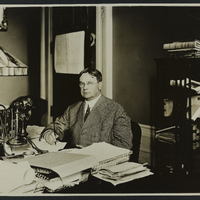
The Progressive Movement transformed California politics in the early twentieth century by promoting government reform, greater public participation, and limits on the influence of powerful corporations and political machines. Women’s suffrage became part of this broader reform agenda. Governor Hiram Johnson (1866–1945) served as California’s 23rd governor from 1911 to 1917 and was a leading figure in the Progressive Movement. Johnson became tied to the suffrage cause through the 1910 California Republican platform, which endorsed women’s right to vote as part of a larger slate of progressive reforms. Motivated by Johnson’s promise to support their political rights, women in California quickly mobilized for him in his bid for governor, organizing grassroots efforts in support of his campaign in multiple counties. As the new governor, he insisted that the Legislature honor his pledge by submitting a women’s suffrage amendment before the Senate on January 6, 1911, only 3 days after he took office.
Date: 1911/1917
-
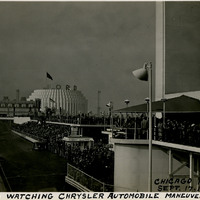
Caption: "Crowd Watching Chrysler Automobile Maneuvers. Chicago Fair. Sept. 17, 1934." Fairgoers pack the stands at a demonstration of the capabilities of Chrysler automobiles on a track created as part of the Chrysler complex built for the Exposition. The Exposition, a world fair attended by thirty-nine million people, celebrated Chicago's one-hundred year anniversary of incorporation. Originally planned to only run from May to November in 1933, it was such a success that its organizers decided to keep it running for a second season from May through October the following year. The central theme of the Exposition was technological innovation, with a motto of "Science Finds, Industry Applies, Man Conforms."
Date: 9/17/1934
-
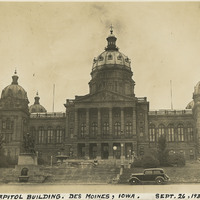
Caption: "State Capitol Building. Des Moines, Iowa. Sept. 26, 1934." Construction began on Iowa's State Capitol Building, designed by John C. Cochrane and Alfred H. Piquenard, in 1871, but was not completed until 1886. Mifflin E. Bell, an assistant to Piquenard, redesigned the central dome after Piquenard's death in 1876. Damage to the building's exterior over the years prompted a massive renovation project, begun in 1983 and completed in 2001.
Date: 9/26/1934
-
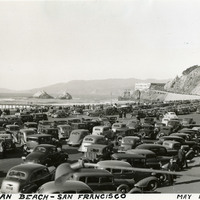
Caption: "Ocean Beach -- San Francisco, May 14, 1934." View of San Francisco's Ocean Beach, with a crowded parking lot in the foreground and the Cliff House (the fourth iteration of this San Francisco landmark) visible just to the right of the photograph's center. The date on this photograph may not be accurate, as several of the vehicles shown appear to date from later in the 1930s.
Date: 5/14/1934