Search All Items

Note: Check the about page for more information on the data sources used in this search

Search Results 741 to 750 of 5331

  • McCarthy Album 08, Photograph 149

    No Caption: c. 1910. View of the Point Adams Lifesaving Station near Hammond, Oregon, including a rowboat ("Point Adams") manned by eight rowers, with one man at the rudder. The Point Adams Lifesaving Station was established in 1889 by the federal government, in response to growing numbers of merchant, fishing, and other sailing vessels along the Columbia River. The stationhouse, visible in the center of the photograph, was demolished in 1939 to make way for a new building. The two-bay boathouse visible at the right had to be moved in 1913-1915 due to erosion of the bank upon which it stood. The U.S. Coastguard took over operation of the station in 1915. The station remained operational until 1967. The remaining buildings now house the Point Adams Research Facility of the Northwest Fisheries Science Center.

    Date: 1910

  • McCarthy Album 08, Photograph 012

    Caption: "Mortar Gun Practice -- Full Service, Fort Worden, Pt Townsend, Wash," c. 1910. The postcard shows several Howitzers, one of which is firing, as well as a group of men standing to the side with their hands over their ears. Construction began on Fort Worden in 1898, and by 1902 it was serving as an active U.S. Army base. Fort Worden was part of the "triangle of fire," three coastal defense fortifications (Fort Casey, Fort Worden, and Fort Flagler) guarding the entrance to Puget Sound. The U.S. sold the property to the state of Washington in 1957. In 1973, the fort and surrounding area opened as Fort Worden State Park.

    Date: 1910

  • McCarthy Album 11, Photograph 295

    Caption: "Church Butte [sic], near Green River, Wyoming. Oct. 2, 1934." The Church Buttes in Wyoming consist of sandstone eroded by wind and weather into a butte approximately 1,000 feet in diameter and rising up to 100 feet above the surrounding valley floor. Located along the Overland Route used by emigrants to the West Coast, the formation gained additional notoriety for being a camp site for Brigham Young and the first Mormon party to head west, as well as a relay site for the Pony Express.

    Date: 10/2/1934

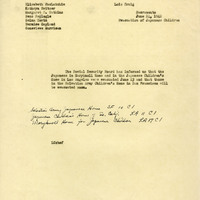
  • Preliminary Report of Investigation of Japanese Charges

    Report submitted by Harry T. Callahan on all individuals of Japanese descent employed by the state as of April 1, 1942

    Date: August 12, 1942

  • McCarthy Album 05, Photograph 213

    Caption: "A.Y.P.E. Seattle Oregon Bldg." View of Oregon Building and bandstand, part of the Alaska-Yukon-Pacific Exposition. Held in Seattle to celebrate the development of the Pacific Northwest, the fair attracted 3.7 million visitors over the course of its run from June to October 1909. Although most of the fair's buildings have since been destroyed, several of them now serve as part of the University of Washington campus.

    Date: 1909
  • McCarthy Album 05, Photograph 100

    No caption, c. 1909-1915. Group of unidentified men gathered around a part of what appears to be a 12-inch mortar at Fort Ruger, Hawaii. Farm buildings and rolling hills appear in the distance. Fort Ruger was established on the Island of O'ahu by the U.S. in 1906 as the Diamond Head Reservation. Its name was changed to Fort Ruger in 1909. See also 96-07-08-alb05-098 and 099.

    Date: 1915

  • McCarthy Album 08, Photograph 205

    Caption: "Theosophists' Headquarters, San Diego.," c. 1905. Palm-lined driveway leading to two large buildings. The Raja Yoga Academy is visible in the center of the photograph, featuring a domed roof and domed turrets at each of the building's corners. At the right stands the Temple of Peace. Both are buildings within the Theosophist complex called Lomaland. The complex housed Theosophists from 1900 to 1942. The area is now part of Point Loma Nazarene University.

    Date: 1905

  • McCarthy Album 11, Photograph 033b

    One side of a flier handed out by the San Antonio Reptile Garden in the mid-1930s entitled "Reptile Facts." The Reptile Garden opened in the 1930s as a fundraising facility for the Witte Museum. The Garden featured turtle races, snake handling demonstrations, fried rattlesnake meat, and rattlesnake dinner fund raisers. It also became a research center for the use of antivenom. The Garden closed in the early 1940s, its live snakes donated to the San Antonio Zoo.

    Date: 1934

  • McCarthy Album 08, Photograph 125

    No Caption: This postcard shows a view of the Government Building and the Cascades (a terraced fountain leading up to the building), part of the Alaska-Yukon-Pacific Exposition. Held in Seattle to celebrate the development of the Pacific Northwest, the fair attracted 3.7 million visitors over the course of its run from June to October 1909. Although most of the fair's buildings have since been destroyed, several of them now serve as part of the University of Washington campus. See also 96-07-08-alb05-212.

    Date: 1909

  • McCarthy Album 11, Photograph 092

    Caption: "Seminole Indian Women Washing Clothes -- Everglades -- Fla. June 30, 1934." Two unidentified women and a small child washing clothing. Several articles of clothing are spread out to dry on a canoe lifted off the ground by sawhorses made of logs. They are likely Seminoles, a Native American tribe in Florida, although most of the tribe had been forcibly relocated from Florida to Oklahoma by 1842. Fewer than 200 remained in Florida after the Third Seminole War ended in 1858, but a resurgence of the tribe occurred in the early to mid twentieth century. The Florida Seminole tribe received federal recognition in 1957.

    Date: 6/30/1934