
Search All Items
Search Results 761 to 770 of 5365
-
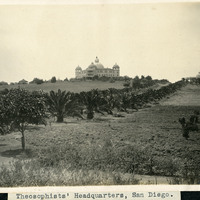
Caption: "Theosophists' Headquarters, San Diego.," c. 1905. Palm-lined driveway leading to two large buildings. The Raja Yoga Academy is visible in the center of the photograph, featuring a domed roof and domed turrets at each of the building's corners. At the right stands the Temple of Peace. Both are buildings within the Theosophist complex called Lomaland. The complex housed Theosophists from 1900 to 1942. The area is now part of Point Loma Nazarene University.
Date: 1905
-
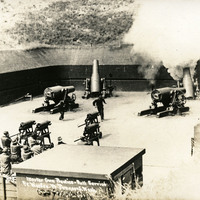
Caption: "Mortar Gun Practice -- Full Service, Fort Worden, Pt Townsend, Wash," c. 1910. The postcard shows several Howitzers, one of which is firing, as well as a group of men standing to the side with their hands over their ears. Construction began on Fort Worden in 1898, and by 1902 it was serving as an active U.S. Army base. Fort Worden was part of the "triangle of fire," three coastal defense fortifications (Fort Casey, Fort Worden, and Fort Flagler) guarding the entrance to Puget Sound. The U.S. sold the property to the state of Washington in 1957. In 1973, the fort and surrounding area opened as Fort Worden State Park.
Date: 1910
-
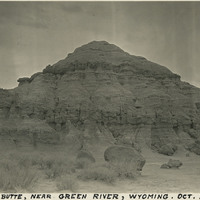
Caption: "Church Butte [sic], near Green River, Wyoming. Oct. 2, 1934." The Church Buttes in Wyoming consist of sandstone eroded by wind and weather into a butte approximately 1,000 feet in diameter and rising up to 100 feet above the surrounding valley floor. Located along the Overland Route used by emigrants to the West Coast, the formation gained additional notoriety for being a camp site for Brigham Young and the first Mormon party to head west, as well as a relay site for the Pony Express.
Date: 10/2/1934
-
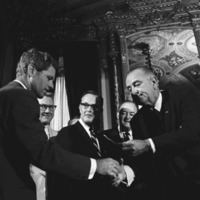
This item has no description.
Date: 1965
-
This item has no description.
Date: 1957
-
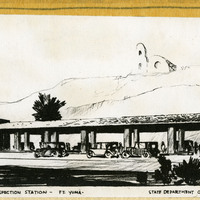
Caption: "Department of Agriculture - Plant Quarantine Inspection Station - Ft. Yuma. State Department of Public Works, Division of Architecture." Design and drawing by Alfred Eichler. Built in 1930. This was one of the first border stations and was situated in desert country; its purpose was to provide a stopping place for inspection of motor traffic coming into California in order to enforce quarantine against insect infestation of California agricultural products. Project for Department of Agriculture.
Date: 1930
-
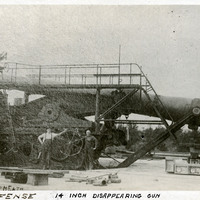
Caption: "Coast Defense: 14 Inch Disappearing Gun." Another copy of a C.D. Heath photograph, this image shows a heavy artillery gun, with two unidentified men standing next to it, at the Sandy Hook Proving Ground. Located at Sandy Hook, New Jersey, the Sandy Hook Proving Ground was used by the U.S. Army to test ordinance and materiel from 1874-1919. See also 96-07-08-alb05-101.
Date: 1910
-
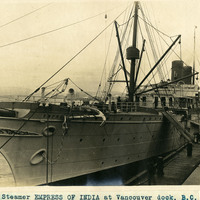
Caption: "Steamer EMPRESS OF INDIA at Vancouver dock, B.C.," c. 1908-1912. View of the Empress of India, built by England's Naval Construction & Armaments Co. in 1890 for the Canadian Pacific Steamships company. The Empress of India could accommodate up to 700 passengers, and was also used to carry mail between Hong Kong and Great Britain. She was sold in 1914 and refitted as a hospital ship for Indian soldiers. She was sold a final time in 1923, for scrap in Bombay.
Date: 1908
-
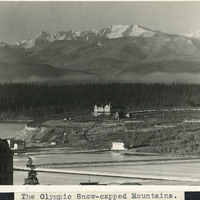
Caption: "The Olympic Snow-capped Mountains.," c. 1908-1912. Vista of the Olympic Mountains in the distance. In the middle distance to the right can be seen the Eisenbeis Castle (now known as the Manresa Castle Restaurant and Lounge), built in 1892 by Charles Eisenbeis, a businessman and Port Townsend's first mayor. The photograph is centered around what appears to be a resort hotel situated a short distance from the Eisenbeis Castle. See also 96-07-08-alb02-058.
Date: 1908
-
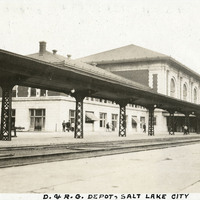
Caption: "D. & R. G. Depot, Salt Lake City," c. 1923. Constructed in 1910 by the Denver and Rio Grande Western Railroad (D&RGW), this depot operated under the auspices of that railroad company until the 1970s. It served as a passenger depot for Amtrak from 1986 to 1999. The building is currently home to the Division of Utah State History and the Utah Department of Heritage & Arts.
Date: 1923