
Search All Items
Search Results 911 to 920 of 6229
-
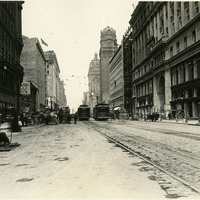
No Caption: A view of the reconstruction on Market Street after the 1906 earthquake and fires, c. 1907.
Date: 1907
-
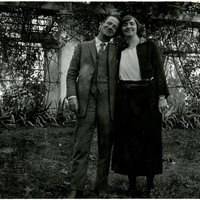
No caption. William McCarthy and an unidentified woman pose in front of a landscaped area with an arbor, c. 1925.
Date: 1925
-
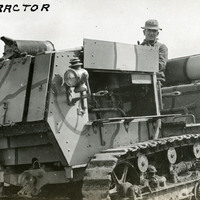
Caption: "5 Ton Tractor," c. 1906. William McCarthy is seen sitting on a military artillery tractor at an unidentified location.
Date: 1906
-
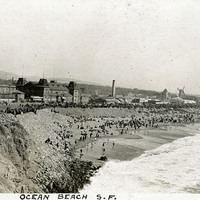
Caption: "Ocean Beach S.F.," c. 1910. View of a crowded Ocean Beach, near San Francisco's Cliff House.
Date: 1910
-
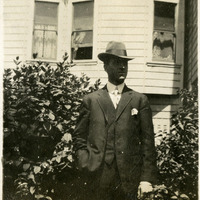
No Caption: An unidentified man standing in front of a house at an unidentified location, c. 1906.
Date: 1906
-
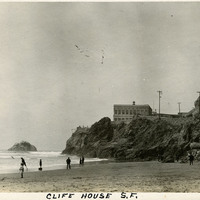
Caption: "Clife [sic] House S.F.," c. 1908-1912. View of San Francisco's Cliff House overlooking Ocean Beach. The building shown here is the fourth iteration of the Cliff House, a neo-classical design built after a fire destroyed the Victorian structure previously at the site in 1907. Reconstruction of the iconic restaurant began in 1908, and a new Cliff House opened in 1909 (the building in this photograph). This neo-classical building was extensively remodeled in the 1930s.
Date: 1908
-
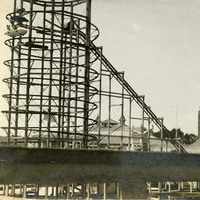
No caption, c. 1910. View of Bisby's Spiral Airship, located in an amusement "zone" known as The Pike in Long Beach, California. One of the earliest suspended roller coasters, this thrill ride operated from about 1902 to 1915. Gondolas suspended below the rails carried riders up a lift to the top of a tower, after which they followed a spiral track back down to the loading area.
Date: 1910
-
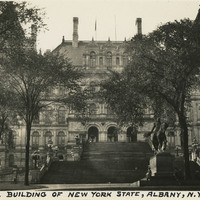
Caption: "Capitol Building of New York State, Albany, N.Y., Sept. 7, 1934." New York State's Capitol Building was constructed between 1867 and 1899. The initial architect, Thomas Fuller, designed the first floor in a Classical or Romanesque style. He was replaced by Leopold Eidlitz and Henry Hobson Richardson, who designed the next two floors in a Renaissance style. The final architect to preside over the project was Isaac G. Perry, who completed the building in a Victorian-Romanesque style. The building was listed on the National Register of Historic Places in 1971, and declared a National Historic Landmark in 1979.
Date: 9/7/1934
-
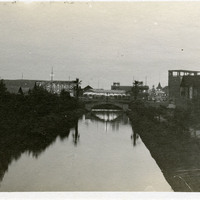
Caption: "Venice," c. 1911. View of canal and bridge in Venice, California, with amusement "zone" in the distance. In 1905, Abbot Kinney built a series of canals as part of a development project along Santa Monica Beach, hoping to recreate the look and feel of Italy's iconic "Floating City" in southern California. Called Ocean Park at first, in 1911, the name officially changed to Venice. By 1929, however, many of the canals had been filled in to create roadways, and those that remained fell into disrepair. A revitalization movement in the early 1990s has restored some of the canals, and made the area a desirable residential neighborhood.
Date: 1911
-
Caption: "Ponciana [sic] and Whitehall Hotels. Ponciana {sic] is the Largest Frame Bldg. Hotel in the World. Palm Beach, Florida. July 8, 1934." Both the Royal Poinciana Hotel (center) and the Whitehall Hotel (far right) can be seen in this photograph, taken from across Lake Worth. The Royal Poinciana, built by Henry Flagler as a resort retreat for wealthy guests, opened in 1894. Renovations eventually enlarged the hotel to a length of 1,800 feet, with over three miles of corridors and hallways, and rooms for over 1,000 guests. At one point, it was reputed to be the largest wood structure in the world. Attendance declined in the 1920s, however, as tourists were attracted to more modern facilities. Damage by a hurricane and the Great Depression combined to close the hotel in 1934. The building was razed a year later. The Whitehall Hotel started its existence as a mansion, also built by Flagler, as a present for his wife. After Flagler's death in 1913, the home was sold to a group of investors who erected an eleven-story tower and converted the entire complex to use as a resort hotel. In 1959, the Henry Morrison Flagler Museum purchased the building. It now serves as a museum.
Date: 7/8/1934