
Search All Items
Search Results 921 to 930 of 5365
-
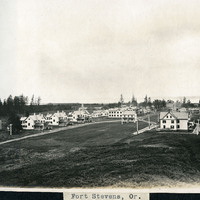
Caption: "Fort Stevens, Or.," c. 1910. View of buildings at Fort Stevens, part of the Three Fort Harbor Defense System protecting the mouth of the Columbia River from enemy incursion or attack (the other forts being Fort Columbia and Fort Canby, both in Washington). Built during the Civil War, the fort remained active until after World War II. In June 1942, Fort Stevens gained the dubious distinction of being the only military installation in the continental United States to come under enemy fire when a Japanese submarine surfaced off the coast and fired seventeen missiles at the fort. The missiles destroyed the backstop to the fort's baseball field, but otherwise did little harm. Fort Stevens was decommissioned in 1947. It was later turned over to the Oregon Parks and Recreation Department, and currently is the site of an Oregon State Park.
Date: 1910
-
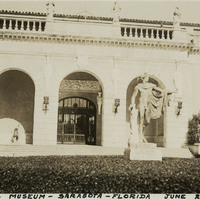
Caption: "Ringling Museum -- Sarasota -- Florida, June 28 1934." Entrance to the John and Mable Ringling Museum of Art, Florida's state art museum established by John and Mable Ringling in 1927. John was a promoter and part-owner of the famous Ringling Brothers Circus, along with four of his brothers. When John and Mable built a winter home in Sarasota in 1926, they also explored the possibility of establishing an art gallery on the same property. Architect John H. Phillips designed the building, which opened to the public in 1931. John Ringling willed the facility and the art collection to the state of Florida upon his death in 1936. The museum, now known simply as "The Ringling," is under the jurisdiction of the University of Florida.
Date: 6/28/1934
-
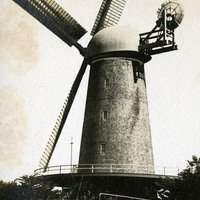
Caption: "MC. Foto" and "Dutch Windmill," c. 1905. This postcard shows the Dutch Windmill in Golden Gate Park, built in 1903 to pump ground water within the park for irrigation purposes.
Date: 1905
-
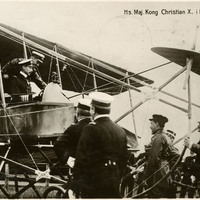
Caption: "Hs. Maj. Kong Christian X. i Flyvemaskine" and "100 Kobenhavn." This postcard shows Denmark's King Christian X in an early biplane. It was sent to William and Grace McCarthy on December 29, 1915.
Date: 1915
-
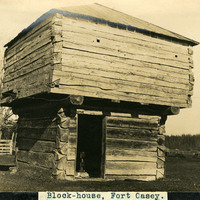
Caption: "Block-house, Fort Casey.," c. 1908-1912. View of a blockhouse, a timber structure built by European settlers to guard against attack during the Indian Wars of 1855-1857. See also 96-07-08-alb08-019.
Date: 1908
-
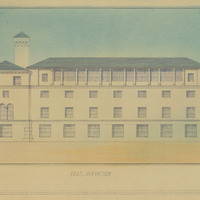
Caption: "East Elevation." Rendered elevation of Scheme No. 1, addition of 4th floor to hospital building, San Quentin State Prison. Sketch in colored pencil by Alfred Eichler. Project for Department of Corrections.
Date: 1934
-
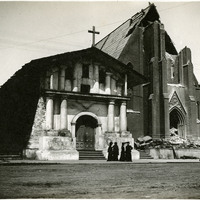
No Caption: Mission Delores, the oldest intact building still standing in San Francisco today, suffered little damage from the 1906 earthquake. The parish church next to it was greatly damaged and rebuilt as the Mission Dolores Basilica, opened in 1918.
Date: 1906
-
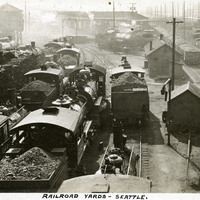
Caption: "Railroad Yards -- Seattle.," c. 1905-1909. View of busy rail yard in Seattle, with a series of trains loaded with what appears to be gravel or rubble, as well as sheds, a water tower, and several other outbuildings.
Date: 1905
-
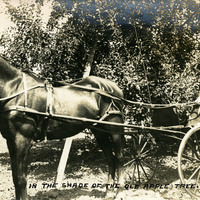
Caption: "In the Shade of the Old Apple Tree," shows William McCarthy sitting in a horse-drawn buggy next to an apple tree, likely on the McCarthy property in Watsonville, c. 1906.
Date: 1906
-
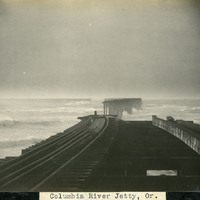
Caption: "Columbia River Jetty, Or.," c. 1905. View of a dilapidated jetty that once carried railroad tracks. Portions of the jetty appear to have been destroyed or washed away.
Date: 1905