
Search All Items
Search Results 931 to 940 of 5365
-
Image withheld due to copyright considerations. For more information, please contact the California State Archives Reference Desk at ArchivesWeb@sos.ca.gov or (916) 653-2246. Caption: "East Bay Span of S.F.-Oakland Bay Bridge, Nov. 12, 1938."
Date: 11/12/1938
-
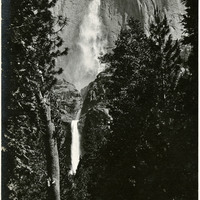
Caption: "Yosemite Falls," c. 1917. Grace McCarthy two unidentified friends pose for a photograph on the trail to Yosemite Falls. Both Upper and Lower Fall can be seen in this photograph. The highest waterfall in Yosemite National Park, Yosemite Falls is made up of two successive cascades falling a total of 2,425 feet from the top of the Upper Fall to the base of the Lower Fall. The Upper Fall alone is 1,430 feet high, and is one of the top twenty highest waterfalls in the world.
Date: 1917
-
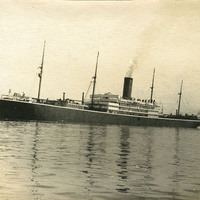
Caption: "Steamer Minnesota, Seattle.," c. 1909. View of the steamship Minnesota II, built in 1903. She was said to be the largest U.S. merchant ship afloat at the time. Operated by the Great Northern Steamship Company, she sailed between the U.S. and markets in Asia until 1915. She was sold at that time, and in 1917 began operating in the Atlantic between the U.S. and the United Kingdom. The U.S. Navy commissioned her as a troop ship in 1919, changing her name to Troy. She brought over 14,000 U.S. troops home from war-torn Europe. She never resumed active service after this, being scrapped in 1923. See also 96-07-08-alb08-166.
Date: 1909
-
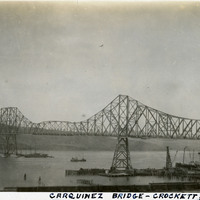
Caption: "Carquinez Bridge -- Crockett, Cal." This photograph shows the original Carquinez Bridge, built to span the Carquinez Strait and thereby contribute to a direct route between Sacramento and San Francisco. The steel cantilevered bridge, designed by Robinson & Steinman, was constructed in 1927. It is no longer extant, having been replaced by two parallel bridges constructed in 1958 and 2003. The structure of the original bridge was removed in 2007. See also 96-07-08-alb11-307 with caption: "Carquinez Bridge, Crockett, California. Oct. 9, 1934."
Date: 10/9/1934
-
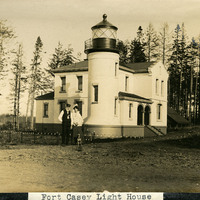
Caption: "Fort Casey Light House [sic]," c. 1905. Located on Whidbey Island in Puget Sound, the Admiralty Head Lighthouse was built overlooking Admiralty Inlet in 1903. It replaced an earlier structure that had to be moved in 1890 to accommodate the construction of Fort Casey. The second lighthouse, shown here, was built with thick walls in order to withstand earthquakes and the concussion of guns at the fort. The man and woman shown in the photograph (standing with a dog) are likely Charles H. Davis and his second wife Delia (Overton) Davis. Charles Davis was appointed keeper of the lighthouse in 1900 and served until his death in 1914. The lighthouse, deactivated in 1922, has since been restored by Washington State Parks, and is part of the Fort Casey State Park. See also 96-07-08-alb02-057.
Date: 1905
-
Caption: "400 Pound Turtles Ready for Shipment -- Key West July 2, 1934." Several slaughtered sea turtles on a wharf in Key West. Turtle meat and eggs were popular food items in the early-to-mid twentieth century; turtle fat was especially prized for making turtle soup. Turtle kraals (corrals) and a cannery were built as the Key West area began to develop. However, the turtle population plummeted in the Florida Keys and surrounding areas as the twentieth century progressed and demand for turtle meat, eggs, and fat increased. The Key West turtle fishing industry halted after the Endangered Species Act was passed in 1971. Turtle populations have since started to recover. The cannery now serves as the Key West Turtle Museum.
Date: 7/2/1934
-
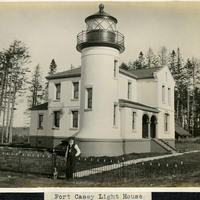
Caption: "Fort Casey Light House [sic]," c. 1905. Located on Whidbey Island in Puget Sound, the Admiralty Head Lighthouse was built overlooking Admiralty Inlet in 1903. It replaced an earlier structure that had to be moved in 1890 to accommodate the construction of Fort Casey. The second lighthouse, shown here, was built with thick walls in order to withstand earthquakes and the concussion of guns at Fort Casey. The man shown in the photograph is likely Charles H. Davis, who was appointed keeper of the lighthouse in 1900 and served until his death in 1914. The lighthouse, deactivated in 1922, has since been restored by Washington State Parks, and is part of the Fort Casey State Park. See also 96-07-08-alb03-065.
Date: 1905
-
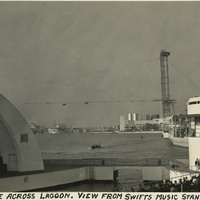
Caption: "Sky Ride Across Lagoon. View from Swifts Music Stand. Chicago Fair, Sept. 18, 1934." One of the 628-foot towers making up the Sky Ride, an aerial tramway which carried fair goers in small gondolas or trams (visible in the center of the photograph) over the harbor around which the Century of Progress Exposition was held. Over 4.5 million passengers enjoyed the views from the Sky Ride before it was demolished after the conclusion of the exposition in 1934. The Exposition, a world fair attended by thirty-nine million people, celebrated Chicago's one-hundred year anniversary of incorporation. Originally planned to only run from May to November in 1933, it was such a success that its organizers decided to keep it running for a second season from May through October the following year. The central theme of the Exposition was technological innovation, with a motto of "Science Finds, Industry Applies, Man Conforms."
Date: 9/18/1934