
Search All Items
Search Results 961 to 970 of 5365
-
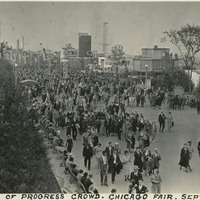
Caption: "Century of Progress Crowd. Chicago Fair. Sept. 16, 1934." A large crowd mills about on a wide thoroughfare in Chicago's Century of Progress Exposition. The Exposition, a world fair attended by thirty-nine million people, celebrated Chicago's one-hundred year anniversary of incorporation. Originally planned to only run from May to November in 1933, it was such a success that its organizers decided to keep it running for a second season from May through October the following year. The central theme of the Exposition was technological innovation, with a motto of "Science Finds, Industry Applies, Man Conforms." None of the buildings constructed for the fair are still extant today, having been built as temporary facilities.
Date: 9/15/1934
-
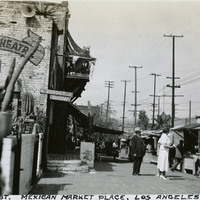
Caption: "Olvera St. Mexican Market Place, Los Angeles, May 18, 1934." View of the Olvera Street Market in Los Angeles. In 1926, Christine Sterling began efforts to preserve the buildings on and around Olvera Street (one of the oldest parts of Los Angeles). After several years of struggle and fundraising, Olvera Street was closed to automobile traffic in 1929, and opened as the Paseo de Los Angeles in 1930. The street and its market quickly became popular tourist sites, promoters touting the area as "A Mexican Street of Yesterday in a City of Today."
Date: 5/18/1934
-
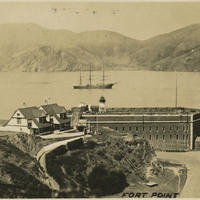
Caption: "Fort Point." c. 1906. See also 96-07-08-alb06-009 with caption: "Fort Point and Golden Gate," and 96-07-08-alb03-118, San Francisco. Fort Point in the foreground, with ships in the bay. Fort Point was part of an effort by the U.S. government to protect the Golden Gate, entrance to the San Francisco Bay. Built between 1853-1861 of brick and mortar, the fort included emplacements for 141 guns but never fired a weapon in defense of the Bay.
Date: 1906
-
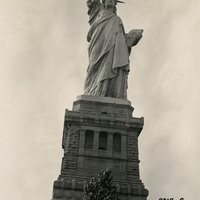
Caption: "Statue of Liberty, New York. Aug 2, 1934." View of the Statue of Liberty on Bedloe Island (now called Liberty Island). Designed by French sculptor Frédéric Auguste Bartholdi, the now-iconic statue was a gift from the people of France to the U.S. Built in segments in France by Gustave Eiffel (also famous for building the Eiffel Tower in Paris), the pieces were shipped from Paris to New York in 1885 and assembled. The Statue of Liberty was subsequently dedicated on October 28, 1886.
Date: 8/2/1934
-
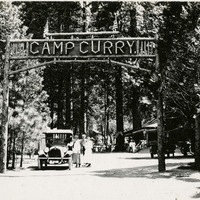
No caption c. 1917. Grace McCarthy and two unidentified people pose under a log sign reading "Camp Curry." Yosemite's Half Dome Village, established by David and Jennie Curry in 1899, was originally called Camp Curry, and later Curry Village. It was designed to provide cheaper accommodations for Yosemite tourists than the resort hotels. The couple set up furnished tents and provided amenities such as a dining tent. The entrance sign seen in this photograph was erected in 1914. As a result of a legal dispute over trademarked names in the park, Curry Village changed its name to Half Dome Village in 2016.
Date: 1917
-
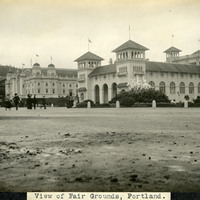
Caption: "View of Fair Grounds, Portland." This photograph shows several buildings of the Lewis and Clark Centennial Exposition, including the Foreign Palace (foreground), the Oriental Palace to its left, and the darkly-colored Forestry Building at the far left. The exposition was held in Portland, Oregon from June 1st to October 15th, 1905. It celebrated the one-hundred year anniversary of the exploratory expedition of the Louisiana Purchase and what became the northwestern part of the United States, led by Meriwether Lewis and William Clark. Some 1.6 million people visited the fair, viewing exhibits from twenty-one countries.
Date: 1905
-
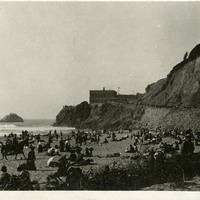
Caption: "Cliff S.F." The Cliff House and Ocean Beach in San Francisco shows people on the beach and walking up the road to the Cliff House, c. 1910. The photograph shows the third Cliff House built on this site, which opened in 1909, and was built with steel-reinforced concrete. The original Cliff House was built in 1863 and was destroyed by fire on Christmas day in 1894. The second, Victorian- style Cliff House was completed in 1896, and although it survived the 1906 earthquake and fires, it burned to the ground in 1907 (see 96-07-08-alb06-280).
Date: 1910
-
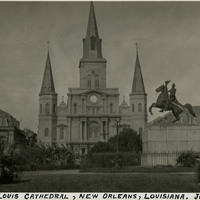
Caption: "Saint Louis Cathedral, New Orleans, Louisiana. June 16, 1934." St. Louis Cathedral anchors one end of Jackson Square in New Orleans' French Quarter. The structure of the cathedral largely dates to the 1850 restoration and expansion of an older cathedral built on the site in 1793. Very little of the older church survived, although the central bell tower (added on to the older church in 1819) was reused in the new structure and is still extant today. A statue of Andrew Jackson mounted on a rearing horse (Clark Mills, sculptor) stands in the square in front of the cathedral. The sculpture was erected in 1856. See also 96-07-08-alb09-231.
Date: 6/15/1934
-
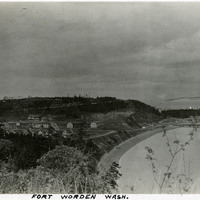
Caption: "Fort Worden Wash.," c. 1909. Fort Worden in Port Townsend, Washington, on Admiralty Inlet of Puget Sound. Construction began on the fort in 1898. By 1902 it was serving as an active U.S. Army base. Fort Worden was part of the "triangle of fire," three coastal defense fortifications (Fort Casey, Fort Worden, and Fort Flagler) guarding the entrance to Puget Sound. The U.S. sold the property to the State of Washington in 1957. In 1973, the fort and surrounding area opened as Fort Worden State Park.
Date: 1909
-
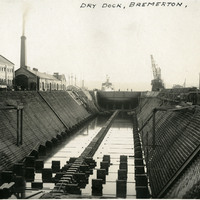
Caption: "Dry Dock, Bremerton." Bremerton, Washington, c. 1908-1912. See also 96-07-08-alb08-085. View of a dry dock at the Puget Sound Naval Shipyard in Bremerton, Washington. Established in 1891 as a naval station, it became Naval Yard Puget Sound in 1901. During World War I the shipyard constructed hundreds of ships to support the war effort, while in World War II, the shipyard was dedicated primarily to repairing damaged ships. Today, it contains a portion of the U.S. Navy's mothball fleet (ships retired but retained in case of future need), as well as building, repairing, and maintaining sea-going vessels of all kinds.
Date: 1908