
Search All Items
Search Results 981 to 990 of 6229
-
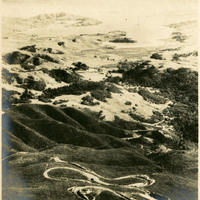
Caption: "Double Bow Knot Mt Tamalpais," c. 1907. A bird's eye view of the twisty road up Mount Tamalpais in Marin County.
Date: 1907
-
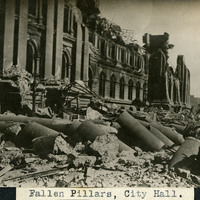
Caption: "Fallen Pillars, City Hall," shows the pillars of San Francisco City Hall that fell into the street as a result of the 1906 earthquake.
Date: 1906
-
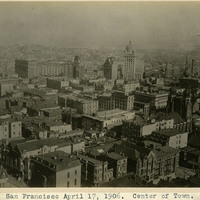
Caption: "San Francisco April 17, 1906. Center of Town." A bird's eye view of the city the day before the earthquake and fires.
Date: 1906
-
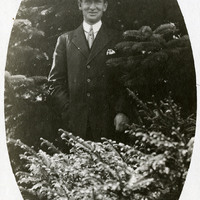
No caption, c. 1910. William McCarthy in suit and bowler hat, posing in a garden or park. See also 96-07-08-alb08-235.
Date: 1910
-
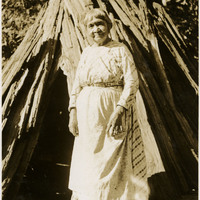
No Caption: An unidentified California Indian woman standing in front of a wigwam covered in tree bark at Yosemite National Park, c. 1935.
Date: 1935
-
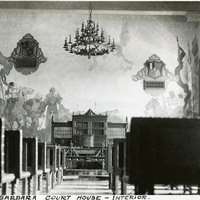
Caption: "Santa Barbara Court House - Interior," c. 1935, shows a view of the murals painted on the interior walls of the courthouse.
Date: 1935
-
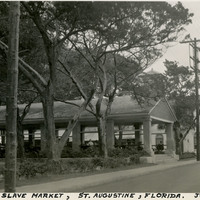
Caption: "Spanish Slave Market, St. Augustine, Florida. July 10, 1934." An open-air pavilion with a gabled roof and six bays appears in the center of this photograph, somewhat obscured by surrounding trees and vegetation. The waterfront site on which the pavilion sits has served St. Augustine as a marketplace since the city's founding in the sixteenth century, for food, commercial goods, and for slaves. The pavilion in the photograph was constructed in 1888, after a fire burned down the previous structure. In the twentieth century, entrepreneurs used the slave market aspect of the site's history as a hook to entice northern tourists into St. Augustine's historic quarter. The market has often served as a rallying site for protestors, from suffragettes to protestors of the war in Iraq. Various civil rights marches held around the market in the 1960s attracted such luminaries as Dr. Martin Luther King, Jr. and Andrew Young.
Date: 7/10/1934
-
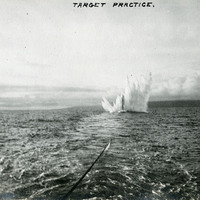
Caption: "Target Practice," c. 1908. This postcard shows a plume of seawater thrown up by a mortar shell during target practice at Fort Point. The facilities at Fort Point were part of an effort by the U.S. government to protect the Golden Gate, entrance to the San Francisco Bay. Built between 1853-1861, the fort included emplacements for 141 guns but never fired a weapon in defense of the Bay. Its name was officially changed in 1882 to Fort Winfield Scott, but in 1886 the fort was officially downgraded to a sub-post of the San Francisco Presidio and the name discontinued. It was resurrected in 1912, with the establishment of a coastal artillery fortification at the Presidio, called, once again, Fort Winfield Scott. See also 96-07-08-alb05-322.
Date: 1908
-
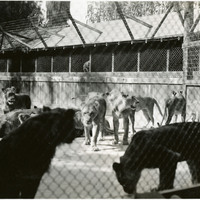
No Caption: Shows a group of adult African lions in a enclosed area of Gay's Lion Farm in El Monte, Los Angeles. Charles and Muriel Gay opened the farm in 1925 and operated it until 1942 as a popular tourist attraction where lions were selectively bred and trained for the Hollywood film industry. It was closed during WWII due to wartime meat shortages, and the lions were loaned to zoos around the country, c. 1935.
Date: 1935
-
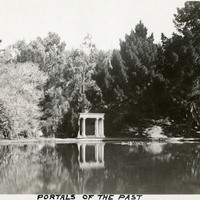
Caption: "Portals of the Past," c. 1915-1920. A monument in Golden Gate Park in San Francisco, on the shores of Lloyd Lake, consisting of a white marble archway and columns. The archway was originally part of the Nob Hill mansion belonging to railroad tycoon Alban Towne. The mansion was destroyed in the 1906 San Francisco earthquake and fire, but the entryway still stood. It was moved to the shore of Lloyd Lake in 1909, as a memorial to the pre-1906 city.
Date: 1920