Bookmarks

Showing Bookmarks 1 to 13 of 13

  • McCarthy Album 04, Photograph 072

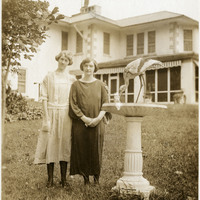
    No caption. Grace McCarthy and an unidentified woman posing beside large bird bath or fountain, in front of the John Shields residence, in the Daybreak Estate area of Long Island.

    Date: 8/27/1934

  • McCarthy Album 08, Photograph 113

    Caption: "Moonlight on the Columbia River, Oregon.," c. 1905. Photograph of the Columbia River at night. A cloudy sky nearly obscures the moon, but allows enough light to see a three-masted schooner and a small sailboat on the river.

    Date: 1905

  • McCarthy Album 11, Photograph 173

    Caption: "Jefferson Davis Highway. U.S. No. 1. Virginia. July 20, 34." Grace McCarthy is standing next to a U.S. Route 1 sign along a highway in Virginia. The Jefferson Davis Highway project was begun by the United Daughters of the Confederacy (UDC). As auto tourism increased across the U.S., so to did the need for roads on which to drive. Private interests such as the UDC began to develop routes across the country, but with no central administrating organization the routes were haphazard and confusing. The UDC planned a route that was to stretch from Virginia across the southern U.S. to San Diego, but the entire route never materialized. The federal government stepped in to impose a numbering system on various routes across the nation. That portion of the planned Jefferson Davis Highway through Virginia was numbered as U.S. Route 1.

    Date: 7/20/1934

  • McCarthy Album 01, Photograph 050

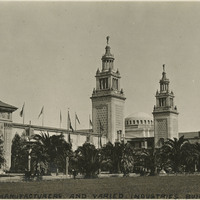
    Caption: "Entrance - Manufacturers Building," at the Panama-Pacific International Exposition.

    Date: 1915

  • McCarthy Album 05, Photograph 219

    Caption: "Ashland Armory," c. 1915-1920. View of the National Guard Armory built in Ashland, Oregon. Designed by Oregon's first State Architect William C. Knighton, the armory has also been used as a community hall since its construction in 1912-1913.

    Date: 1915

  • McCarthy Album 05, Photograph 199

    Caption: "12" Disappearing Gun," c. 1915. Looking up at the undercarriage of a 12" disappearing gun aimed over a high parapet. Retracting or disappearing guns were a form of artillery developed in the nineteenth century in which heavy artillery guns were placed on rotating carriages that allowed retraction of the weapon after firing, to enable reloading while under enemy fire.

    Date: 1915

  • McCarthy Album 06, Photograph 299

    Caption: "Big Tree Grove - Santa Cruz," c. 1910.

    Date: 1910

  • McCarthy Album 07, Photograph 084

    Caption: "Fountain of the Earth," (Robert I. Aitken, sculptor), at the Panama-Pacific International Exposition. See also 96-07-08-alb01-065.

    Date: 1915

  • McCarthy Album 06, Photograph 172

    No caption. Caption in photograph album (172.0): "City Hall Tower Before and after the Quake." 1906. A view of San Francisco City Hall before the April 18, 1906 earthquake.

    Date: 1906

  • McCarthy Album 04, Photograph 200

    Caption: "Santa Cruz Big Trees," c. 1920. Grace McCarthy standing in a grove of giant sequoias near Santa Cruz, California.

    Date: 1920

  • McCarthy Album 01, Photograph 091

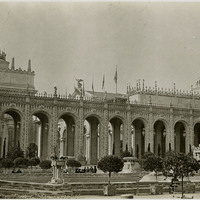
    Caption: "Beauty and the Beast Fountain" (Edgar Walter, sculptor), in the Court of Flowers at the Panama-Pacific International Exposition.

    Date: 1915

  • McCarthy Album 07, Photograph 069

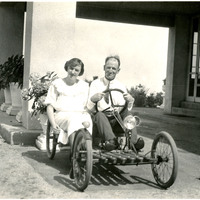
    No Caption: Unidentified man and woman at the Panama-Pacific International Exposition. See also 96-07-08-alb01-053.

    Date: 1915

  • McCarthy Album 11, Photograph 196

    Caption: "Independence Hall -- Phila. July 31, 1934." A view of the steeple and bell tower of Independence Hall in Philadelphia, site of the debate over and signing of both the Declaration of Independence and the U.S. Constitution. Completed in 1753 for the use of the Pennsylvania Province's colonial legislature, it was also the site of a 1915 convention marking the formation of the League to Enforce Peace, predecessor entity to the United Nations. The Georgian-style building, designed by Edmund Woolley and Andrew Hamilton, has undergone several renovations. Only the central portion of the building is original -- all other portions of the building have been rebuilt at some point in its past. This building also housed the Liberty Bell until 1976, when the bell was moved to the Liberty Bell Center across the street.

    Date: 7/31/1934