Bookmarks

Showing Bookmarks 1 to 10 of 10

  • McCarthy Album 05, Photograph 200

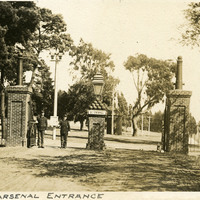
    Caption: "Benicia Arsenal Entrance," c. 1915. View of the gateway to Benicia Arsenal, where William McCarthy worked (starting in 1903). Established in 1851, the Benicia Arsenal was the primary ordnance facility of the U.S. Army on the West Coast. The facility was deactivated in 1963, and closed completely the following year. The area now serves a vastly different function, providing work and retail space for artists and artisans.

    Date: 1915

  • McCarthy Album 04, Photograph 191

    Caption: "Lake Tahoe," c. 1915-1920. William and Grace McCarthy posing for a photograph with an unidentified young woman, on a steep hillside in front of pine trees.

    Date: 1920

  • McCarthy Album 10, Photograph 080

    Caption: "One of the Main Barracks, March Field, Calif.," c. 1935. Today known as March Air Reserve Base, March Field was one of several airfields established in April 1917, just after the United State's entry in World War 1. The airfield was named for Peyton C. March Jr., son of then Army Chief of Staff, Peyton C. March, who had been killed in an air crash just fifteen days after being commissioned.

    Date: 1935

  • McCarthy Album 11, Photograph 240

    Caption: "Historic North Church, Boston. Where Signal was Hung for Paul Revere, Sept. 5, 1934." View of the clock tower and steeple of the Old North Church, built in 1723. The church is said to be the site where Paul Revere, after his famous midnight ride, caused two lanterns to be hung as the signal that British troops were advancing into the area by sea rather than by land.

    Date: 9/5/1934

  • McCarthy Album 11, Photograph 173

    Caption: "Jefferson Davis Highway. U.S. No. 1. Virginia. July 20, 34." Grace McCarthy is standing next to a U.S. Route 1 sign along a highway in Virginia. The Jefferson Davis Highway project was begun by the United Daughters of the Confederacy (UDC). As auto tourism increased across the U.S., so to did the need for roads on which to drive. Private interests such as the UDC began to develop routes across the country, but with no central administrating organization the routes were haphazard and confusing. The UDC planned a route that was to stretch from Virginia across the southern U.S. to San Diego, but the entire route never materialized. The federal government stepped in to impose a numbering system on various routes across the nation. That portion of the planned Jefferson Davis Highway through Virginia was numbered as U.S. Route 1.

    Date: 7/20/1934

  • McCarthy Album 10, Photograph 035

    Caption: "Aimee McPherson's Angeles Temple- Los Angeles," c. 1935. Aimee Semple McPherson, also known as Sister Aimee was a Canadian-American Pentecostal evangelist and media celebrity in the 1920s and 1930s, famous for her theatrical sermons and claims of healing the sick, and for founding the Foursquare Church.

    Date: 1935

  • McCarthy Album 06, Photograph 204

    Caption: "Street Car Strike," c. 1907. San Francisco's street car union workers called for a strike after their request to be paid three dollars per eight- hour work day was declined. At the start of the strike, two strikers were shot by strike breakers and many more causalities were reported. Hundreds of passengers were injured during the strike due to inexperienced operators, and twenty-five of those passengers died as a result. In total, the upheaval resulted in thirty-one causalities.

    Date: 1907

  • Escarpin, or Las Salinas or El Tucho Rancho

    Hand-drawn sketch map of Escarpin, or Las Salinas or El Tucho boundaries. Volume 1, page 26.

    Date: 1835

  • McCarthy Album 06, Photograph 291

    No caption. A view of numerous and well-lit ships at night in the San Francisco Bay, during a visit by the Atlantic Fleet in 1908.

    Date: 1908

  • McCarthy Album 11, Photograph 196

    Caption: "Independence Hall -- Phila. July 31, 1934." A view of the steeple and bell tower of Independence Hall in Philadelphia, site of the debate over and signing of both the Declaration of Independence and the U.S. Constitution. Completed in 1753 for the use of the Pennsylvania Province's colonial legislature, it was also the site of a 1915 convention marking the formation of the League to Enforce Peace, predecessor entity to the United Nations. The Georgian-style building, designed by Edmund Woolley and Andrew Hamilton, has undergone several renovations. Only the central portion of the building is original -- all other portions of the building have been rebuilt at some point in its past. This building also housed the Liberty Bell until 1976, when the bell was moved to the Liberty Bell Center across the street.

    Date: 7/31/1934