
Bookmarks
Showing Bookmarks 1 to 4 of 4
-
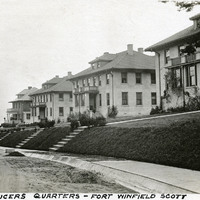
Caption: "Officers Quarters -- Fort Winfield Scott," c. 1912. Shows a row of multi-story homes along a landscaped street. Fort Winfield Scott was a coastal artillery post at the San Francisco Presidio. Originally named Fort Point, it was part of an effort by the U.S. government to protect the Golden Gate, entrance to the San Francisco Bay. Built between 1853-1861, the fort included emplacements for 141 guns but never fired a weapon in defense of the Bay. Its name was officially changed in 1882 to Fort Winfield Scott. This only lasted four years, until 1886 when the fort was officially downgraded to a sub-post of the San Francisco Presidio and the name discontinued. It was resurrected in 1912, with the establishment of a coastal artillery fortification at the Presidio, called, once again, Fort Winfield Scott.
Date: 1912
-
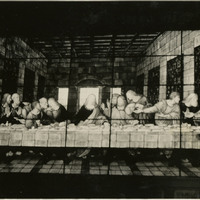
No Caption: " A stained glass reproduction of Leonardo da Vinci's Last Supper in the Memorial Court of Honor at Forest Lawn Memorial Park in Glendale, Los Angeles, c. 1935.
Date: 1935
-
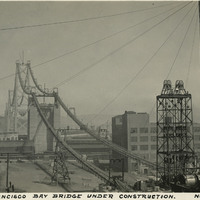
Caption: "San Francisco Bay Bridge Under Construction. Nov. 1, 1935." View of the towers and suspension cables of the western half of the San Francisco-Oakland Bay Bridge, spanning the distance between Yerba Buena Island in San Francisco Bay to the City of San Francisco. The bridge deck has not yet been completed. The Bay Bridge's design combined three different types of bridge-building technology over the five miles it covers between San Francisco and Oakland: a suspension span, a cantilevered span, and a tunnel. At the time of its completion in 1936, the bridge was the longest steel structure on the globe. It also featured the deepest bridge pier ever built, and the world's largest bore tunnel.
Date: 11/1/1935
-
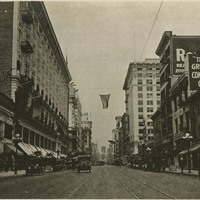
No Caption: c. 1915. Shows a view of Broadway in Los Angeles. On the right side of the street is Woodley Theatre, a vaudeville theater that opened in 1913.
Date: 1915