Bookmarks

Showing Bookmarks 1 to 5 of 5

  • McCarthy Album 08, Photograph 032

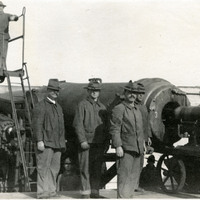
    No Caption: c. 1908-1912. Group of men posing around a 12-inch disappearing gun. Retracting or disappearing guns were a form of artillery developed in the nineteenth century in which heavy artillery guns were placed on rotating carriages that allowed retraction of the weapon after firing, to enable reloading while under enemy fire. Such guns were often used in coastal fortifications.

    Date: 1908

  • McCarthy Album 07, Photograph 259

    Caption: "Crossing the Line California to Nevada," c. 1915, shows railroad tracks intersecting the border between California and Nevada in the Sierra Nevada.

    Date: 1915

  • McCarthy Album 09, Photograph 113

    Caption: "Republic Statue Jackson Park Chicago," c. 1925. Designed by Chester French (sculptor), this version of the Statue of the Republic has stood in Chicago's Jackson Park since its construction in 1918. It is a one-third replica of a statue at the World's Columbian Exposition, held at Chicago in 1893.

    Date: 1925

  • McCarthy Album 08, Photograph 118

    Caption: "Sea Side, Oregon.," undated. View of a beach along the Oregon coastline, with a rocky cliffs and ocean waves breaking.

    Date: Undated

  • McCarthy Album 05, Photograph 124

    Caption: "Annheuser Busch Residence. Los Angeles," c. 1906. Unidentified woman standing in front of Tudor-style mansion, with several gables and chimneys covered in ivy. Built in 1898 in Pasadena and designed by Frederick Roehrig, the Ivy Wall (the mansion's nickname) was purchased by Adolphus Busch in 1905. Busch gradually bought up much of the surrounding property, and subsequently created the first Busch Gardens. After his death in 1913, his wife Lily continued to develop the gardens. Lily died in 1928. Over the next two decades, the gardens were gradually sold off to real estate developers. The Ivy Wall itself was torn down in 1952.

    Date: 1906