Bookmarks
Showing Bookmarks 1 to 12 of 12
-
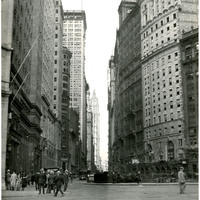
Caption: "Broadway At Bowling Green N.Y." Street scene in New York City, showing Broadway near the small public park Bowling Green. See also 96-07-08-alb04-076 and 96-07-08-alb11-233.
Date: 8/31/1934
-
Caption: "#2 -- Record Oct 25, 09." This postcard shows plume of seawater thrown up by a mortar shell during target practice at Fort Point. The facilities at Fort Point were part of an effort by the U.S. government to protect the Golden Gate, entrance to the San Francisco Bay. Built between 1853-1861, the fort included emplacements for 141 guns but never fired a weapon in defense of the Bay. Its name was officially changed in 1882 to Fort Winfield Scott. This only lasted four years, however, for in 1886 the fort was officially downgraded to a sub-post of the San Francisco Presidio and the name discontinued. It was resurrected in 1912, however, with the establishment of a coastal artillery fortification at the Presidio, called, once again, Fort Winfield Scott.
Date: 1909-10-25
-
Caption: "Washington," State of Washington Building at the Panama-Pacific International Exposition. See also 96-07-08-alb01-138.
Date: 1915
-
Caption: "Benicia Arsenal Store House," c. 1905. The Benicia Arsenal Store House, also known as the Clocktower building, was erected in 1859 at three stories high. In 1912, an explosion and fire caused extensive damage, after which it was rebuilt as a two-story structure.
Date: 1905
-
Caption: "Michigan Avenue and Business Section, Chicago. Ill. Sept. 15, 1934." View of a portion of Chicago's skyline from Michigan Avenue.
Date: 9/15/1934
-
No Caption: Grace McCarthy standing in front of a door at an unidentified location, c. 1906.
Date: 1906
-
Caption: "Longfellow Bridge, Boston, Mass. Sept. 5, 1934." The Longfellow Bridge spans the Charles River between Boston and Cambridge. Originally called the Cambridge Bridge, it replaced a wood structure called the West Boston Bridge that had been constructed in 1793. This wood bridge was unable to handle large volumes of traffic or the introduction of street cars, so a new bridge was built in the early twentieth century. Opened in 1906 as the Cambridge Bridge, the name was changed in 1927 to the Longfellow Bridge in honor of poet Henry Wadsworth Longfellow. It is colloquially known as the Salt and Pepper Bridge, as its central towers are reminiscent in shape of salt and pepper shakers.
Date: 9/5/1934
-
No caption: Grace McCarthy (right) and an unidentified women, likely her sister, sitting in a parlor at an unidentified location, c. 1906.
Date: 1906
-
-
No Caption: William and Grace McCarthy standing before the Fountain of Energy (A. Stirling Calder, sculptor), at the Panama-Pacific International Exposition. See also 96-07-08-alb01-055.
Date: 1915
-
Caption: "Government exhibits of clothing, Government Building." This exhibit demonstrates a variety of military uniforms, displayed on mannequins. It was located in the Government Building of the Lewis and Clark Centennial Exposition, held in Portland, Oregon from June 1st to October 15th, 1905. It celebrated the one-hundred year anniversary of the exploratory expedition of the Louisiana Purchase and what became the northwestern part of the United States, led by Meriwether Lewis and William Clark. Some 1.6 million people visited the fair, viewing exhibits from twenty-one countries.
Date: 1905
-
Caption: "Crown Point.," c. 1920. Shows the Vista House, built in 1918 as a memorial to Oregon's pioneers. Designed by Edgar M. Lazarus, it sits atop Crown Point, a rocky promontory overlooking the Columbia River gorge, along the Historic Columbia River Highway.
Date: 1920