Bookmarks

Showing Bookmarks 1 to 7 of 7

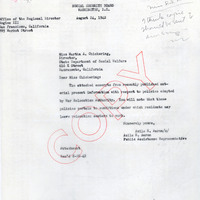
  • Correspondence on Policy

    Correspondence from Azile H. Aaron to Martha A. Chickering regarding policies adopted by the War Relocation Authority; Attachments: "Excerpt from Information Digest No. 520" (F3729_65_007b), "Excerpt from Victory" (F3729_65_007c)

    Date: August 24, 1942

  • McCarthy Album 08, Photograph 017

    Caption: "Fort Casey Barracks," c. 1908-1912. View of two barracks buildings at Fort Casey, located on Whidbey Island in Puget Sound. Construction began on the fort in 1897. Fort Casey was part of the "triangle of fire," three coastal defense fortifications (Fort Casey, Fort Worden, and Fort Flagler) guarding the entrance to Puget Sound. The U.S. Army used the facility until the 1950s, when the fort was decommissioned. The area is now a state park.

    Date: 1908

  • Old Series Trademark No. 1554

    Scott Brothers Pure Extracts

    Date: 1887

  • Statement by Warren on Tule Lake

    Statement by Governor Warren on Japanese internment camp at Tule Lake, as quoted by Sacramento Bee, November 5, 1943

    Date: Undated

  • Old Series Trademark No. 1744

    El Captain, Yosemite

    Date: 1889

  • Old Series Trademark No. 1422b

    Sanitary Cigar

    Date: 1887

  • McCarthy Album 08, Photograph 239

    Caption: "Fort Point," c. 1910. This postcard shows a view of Fort Point, at the entrance to San Francisco Bay. The facilities at Fort Point were part of an effort by the U.S. government to protect the Golden Gate, entrance to the San Francisco Bay. Built between 1853-1861, the fort included emplacements for 141 guns but never fired a weapon in defense of the Bay. Its name was officially changed in 1882 to Fort Winfield Scott, but in 1886 the fort was officially downgraded to a sub-post of the San Francisco Presidio and the name discontinued. It was resurrected in 1912, with the establishment of a coastal artillery fortification at the Presidio, called, once again, Fort Winfield Scott.

    Date: 1910