Bookmarks

Showing Bookmarks 1 to 13 of 13

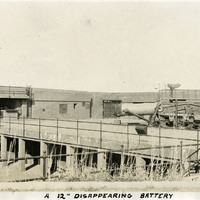
  • McCarthy Album 05, Photograph 198

    Caption: "A 12" Disappearing Battery," c. 1915. View of a barbette equipped with a 12" disappearing gun. Retracting or disappearing guns were a form of artillery developed in the nineteenth century in which heavy artillery guns were placed on rotating carriages that allowed retraction of the weapon after firing, to enable reloading while under enemy fire.

    Date: 1915

  • Old Series Trademark No. 3523

    True Blue Serge

    Date: 1899

  • Old Series Trademark No. 3459
  • McCarthy Album 05, Photograph 321

    Caption: "#2 -- Record Oct 25, 09." This postcard shows plume of seawater thrown up by a mortar shell during target practice at Fort Point. The facilities at Fort Point were part of an effort by the U.S. government to protect the Golden Gate, entrance to the San Francisco Bay. Built between 1853-1861, the fort included emplacements for 141 guns but never fired a weapon in defense of the Bay. Its name was officially changed in 1882 to Fort Winfield Scott. This only lasted four years, however, for in 1886 the fort was officially downgraded to a sub-post of the San Francisco Presidio and the name discontinued. It was resurrected in 1912, however, with the establishment of a coastal artillery fortification at the Presidio, called, once again, Fort Winfield Scott.

    Date: 1909-10-25

  • McCarthy Album 10, Photograph 239

    Caption: "The Clark Crow gets a peanut. Rainier National Park," c. 1935, shows William McCarthy feeding a Clark Crow.

    Date: 1935

  • Old Series Trademark No. 3213

    O.B.C. monogram

    Date: 1898

  • Old Series Trademark No. 0173

    Excelsior Cash Prize Candy

    Date: 1870

  • McCarthy Album 04, Photograph 286

    No caption, c. 1935. Ice skating rink at Curry Village in Yosemite National Park, built in 1929 at the location now occupied by the Curry Village parking lot.

    Date: 1935

  • McCarthy Album 08, Photograph 166

    Caption: "Steamer MINNESOTA," c. 1909. View of the steamship Minnesota II, built in 1903. She was said to be the largest U.S. merchant ship afloat at the time. Operated by the Great Northern Steamship Company, she sailed between the U.S. and markets in Asia until 1915. In 1917 the Minnesota II began operating in the Atlantic between the U.S. and the United Kingdom. The U.S. Navy commissioned her as a troop ship in 1919, changing her name to Troy. She brought over 14,000 U.S. troops home from war-torn Europe. She never resumed active service after this, being scrapped in 1923. See also 96-07-08-alb08-111.

    Date: 1909

  • McCarthy Album 04, Photograph 207

    No caption, c. 1920. William (kneeling in front) and Grace McCarthy (far right) on Santa Cruz beach with two unidentified women, all in swimsuits. See also 96-07-08-alb04-208, 209.

    Date: 1920

  • McCarthy Album 05, Photograph 254

    Caption: "S.P. Co. One of the Big Compound Engines -- Reno Nevada," c. 1910. Southern Pacific Railroad Company locomotive and accompanying rail cars in Reno, Nevada.

    Date: 1910

  • McCarthy Album 11, Photograph 267

    Caption: "Michigan Avenue and Business Section, Chicago. Ill. Sept. 15, 1934." View of a portion of Chicago's skyline from Michigan Avenue.

    Date: 9/15/1934

  • McCarthy Album 10, Photograph 224

    Caption: "Butcharts Gardens, Victoria, B.C." c. 1935.

    Date: 1935