Bookmarks

Showing Bookmarks 1 to 5 of 5

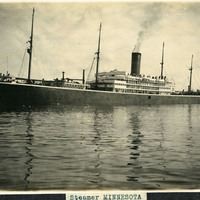
  • McCarthy Album 08, Photograph 166

    Caption: "Steamer MINNESOTA," c. 1909. View of the steamship Minnesota II, built in 1903. She was said to be the largest U.S. merchant ship afloat at the time. Operated by the Great Northern Steamship Company, she sailed between the U.S. and markets in Asia until 1915. In 1917 the Minnesota II began operating in the Atlantic between the U.S. and the United Kingdom. The U.S. Navy commissioned her as a troop ship in 1919, changing her name to Troy. She brought over 14,000 U.S. troops home from war-torn Europe. She never resumed active service after this, being scrapped in 1923. See also 96-07-08-alb08-111.

    Date: 1909

  • McCarthy Album 04, Photograph 205

    Caption: "Del Monte," c. 1920. Five unidentified women standing in front of a palm tree on the grounds of the Hotel Del Monte. The photograph shows the second of three hotels built on the site, near Monterey, California (this building was destroyed by fire in 1924). The property surrounding the hotel became known as Pebble Beach.

    Date: 1920

  • McCarthy Album 03, Photograph 116

    Caption: "Japanese Tea Garden Golden Gate Park," San Francisco, c. 1907. Originally created as a "Japanese Village" exhibit for the 1894 California Midwinter International Exposition, the still existing Japanese Tea Garden is now the oldest public Japanese garden in the United States.

    Date: 1907

  • McCarthy Album 04, Photograph 223

    Caption: "Healdsburg Bridge," c. 1921. The Healdsburg Memorial Bridge, built in 1921, is a pin-connected Pennsylvania through truss structure across the Russian River in Sonoma County, near Healdsburg. A line of people stands at the bridge railing in this photograph.

    Date: 1921

  • McCarthy Album 05, Photograph 130

    Caption: "Portion of Interior. Fort Point.," c. 1906. View of arched colonnades on ground and middle floors of Fort Point, and an upper tier with barbettes for the future installation of heavy artillery coastal defense weapons. The facilities at Fort Point were part of an effort by the U.S. government to protect the Golden Gate, entrance to the San Francisco Bay. Built between 1853-1861, the fort included emplacements for 141 guns but never fired a weapon in defense of the Bay. Its name was officially changed in 1882 to Fort Winfield Scott, but in 1886 the fort was officially downgraded to a sub-post of the San Francisco Presidio and the name discontinued. It was resurrected in 1912, with the establishment of a coastal artillery fortification at the Presidio, called, once again, Fort Winfield Scott.

    Date: 1906