Bookmarks

Showing Bookmarks 1 to 12 of 12

  • McCarthy Album 07, Photograph 242

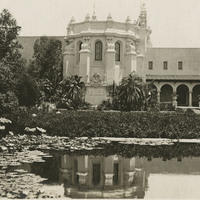
    No Caption: Shows the reflecting pool at the Panama-California Exposition in San Diego. See also 96-07-08-alb01-163, with caption: "La Laguna Espejada. P.C. Exp. San Diego July 18, 1915."

    Date: 1915

  • McCarthy Album 10, Photograph 189

    Caption: "Lake Louise - Alberta, Canada," c. 1935, shows the luxury Chateau Lake Louise Hotel in the distance.

    Date: 1935

  • McCarthy Album 10, Photograph 091

    Caption: "Colorado River Spillway From Boulder Dam," c. 1935.

    Date: 1935

  • McCarthy Album 05, Photograph 118

    Caption: "Sutter [sic] Fort. Sacramento.," c. 1920. Image of the main building of Sutter's Fort. John Sutter established the fort in 1839, calling it New Helvetia. After the discovery of gold at one of Sutter's mills (at Coloma, on the American River), almost all of the fort's inhabitants left for the gold fields in the foothills. The fort deteriorated until being restored from 1891-1893. The fort is now the site of a State Historic Park. See also 96-07-08-alb05-117.

    Date: 1920

  • McCarthy Album 09, Photograph 290

    Caption: "California," c, 1917. The McCarthy's vehicle is squeezed into the tunnel carved through the California Tree, a Giant Sequoia in the Mariposa Grove of Yosemite National Park. The tunnel was cut through the tree in 1895 to facilitate travel on the road into the grove, and also as a tourist attraction. It is now the only living Giant Sequoia with a tunnel cut through it (so-called "tunnel trees"), the others having all fallen.

    Date: 1917

  • McCarthy Album 10, Photograph 262

    Caption: "Crater Lake - View from the Lodge," c. 1935, shows clouds and sky reflected in the lake. Located in the Crater Lake National Park, Crater Lake is a caldera lake formed about 7,700 years ago by the collapse of the volcano, Mount Mazama. Its 1,949 foot depth makes it the deepest lake in the United States.

    Date: 1935

  • McCarthy Album 05, Photograph 026

    Caption: "Machine Shop -- Fort Winfield Scott," c. 1913. Low brick building with tile roof, with William McCarthy (far left) and two unidentified men standing in front. Fort Winfield Scott, formerly Fort Point, was part of an effort by the U.S. government to protect the Golden Gate, entrance to the San Francisco Bay. Built between 1853-1861, the fort included emplacements for 141 guns but never fired a weapon in defense of the Bay. Its name was officially changed in 1882 to Fort Winfield Scott. This only lasted four years, however, for in 1886 the fort was officially downgraded to a sub-post of the San Francisco Presidio and the name discontinued. It was resurrected in 1912, with the establishment of a coastal artillery fortification at the Presidio, called, once again, Fort Winfield Scott.

    Date: 1913

  • Correspondence on Fear of Deportation

    Correspondence from Bertha S. Underhill to Mary LeHane regarding assistance and deportation; response to Memo on Fear of Deportation (F3729_109_001b)

    Date: April 6, 1945

  • "Meeting on Resettlement Assistance"

    Summary of meeting on January 11, which covered difficulties during resettlement like housing and employment

    Date: January 15, 1946

  • Memo on Alameda County Cases

    Office Memorandum from Bertha S. Underhill to Genevieve Jefferson regarding payment for repairs to home

    Date: February 27, 1946

  • McCarthy Album 05, Photograph 136

    Caption: "Market St. Sept 9. 1910 S.F." Market Street in San Francisco, decked with bunting and flags for California's Admissions Day, the anniversary of the Golden State's entry as a state in the U.S. See also 96-07-08-alb07-008.

    Date: 1910-09-09

  • McCarthy Album 05, Photograph 138

    No caption, c. 1906. Grace McCarthy in a dress suit and feather-plumed hat, posing next to a stream.

    Date: 1906