

Bookmarks
Showing Bookmarks 1 to 13 of 13
-
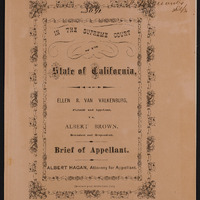
A Brief of Appellant is filed in the appellate court by the party who lost in the previous trial and argues in favor of appealing a lower court’s decision. Ellen Van Valkenburg began an important legal battle for women’s enfranchisement in California on July 21, 1871, when she requested that Santa Cruz County Clerk Albert Brown enter her name in the Great Register of voters. After Brown (a willing accomplice in helping her bring the case to court) refused to register her, Van Valkenburg and her lawyer, Santa Cruz Judge Albert Hagan, began legal proceedings by requesting a writ of mandamus, a judicial remedy used to compel agencies to perform ministerial acts, such as registering voters. Van Valkenburg and Hagan argued her case by citing the 14th Amendment of the U.S. Constitution. The new amendment, ratified 3 years earlier in 1868, defined all persons born or naturalized in the U.S. as citizens protected by civil rights. Van Valkenburg and Hagan asserted that American women were considered citizens under this amendment, and that citizenship automatically granted absolute rights, including the right to vote. The case first went to California’s Third District Court. Many of America’s most prominent suffragists, including Elizabeth Cady Stanton and Susan B. Anthony, were with Van Valkenburg in Santa Cruz when the lower court ruled against her on August 16, 1871. Van Valkenburg and Hagan swiftly appealed this decision through the Supreme Court of California. In the end, the Supreme Court of California upheld the lower court’s verdict under the reasoning that as a white American woman, Van Valkenburg already had citizenship and civil rights prior to the passage of the 14th amendment, and that the 14th amendment did not provide her with any additional political rights, such as the right to vote. While Van Valkenburg lost her case, and subsequent lawsuits failed to secure women's suffrage nationwide, the case stands as a critical early example of legal advocacy for women's political rights in California.
Date: September 29, 1871
-

-

This item has no description.
Date: 2007
-
This item has no description.
Date: 1970
-

-
-
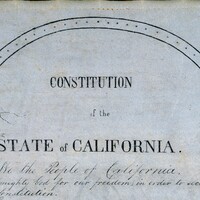
Image of the title page of the orginial Constitution of the State of California.
Date: 1849
-
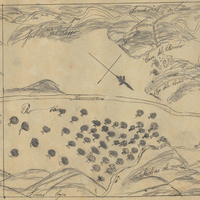
Hand-drawn sketch map of Ojo de Agua de la Coche boundaries. Volume 1, page 60.
Date: 1835
-
This item has no description.
Date: undated
-

Caption: "Portland Fair," Portland, Oregon, 1905. The Lewis and Clark Exposition was held in Portland, Oregon, from June 1st to October 15th, 1905. It celebrated the one-hundred year anniversary of the exploratory expedition of the Louisiana Purchase and what became the northwestern part of the United States, led by Meriwether Lewis and William Clark. Some 1.6 million people visited the fair, viewing exhibits from twenty-one countries.
Date: 1905
-
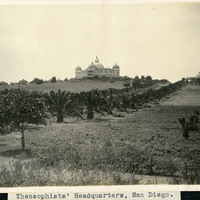
Caption: "Theosophists' Headquarters, San Diego.," c. 1905. Palm-lined driveway leading to two large buildings. The Raja Yoga Academy is visible in the center of the photograph, featuring a domed roof and domed turrets at each of the building's corners. At the right stands the Temple of Peace. Both are buildings within the Theosophist complex called Lomaland. The complex housed Theosophists from 1900 to 1942. The area is now part of Point Loma Nazarene University.
Date: 1905
-

Caption: "Fountain - Rising Sun," (Adolph A. Weinman, sculptor), at the Panama-Pacific International Exposition. See also 96-07-08-alb01-089.
Date: 1915
-
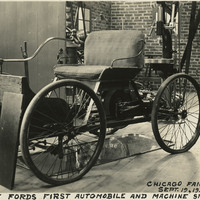
Caption: "Henry Ford's First Automobile and Machine Shop, Chicago Fair Exhibit. Sept. 19, 1934." This exhibit within the Ford Building at Chicago's Century of Progress Exposition replicated Henry Ford's original workshop, including a Quadricycle, the first automobile produced by Ford. The Exposition, a world fair attended by thirty-nine million people, celebrated Chicago's one-hundred year anniversary of incorporation. Originally planned to only run from May to November in 1933, it was such a success that its organizers decided to keep it running for a second season from May through October the following year. The central theme of the Exposition was technological innovation, with a motto of "Science Finds, Industry Applies, Man Conforms."
Date: 9/19/1934