
Search All Items
- Filters:
- Language
- English 7958
- Spanish 495
- ENGLISH 4
- English 2
- census_013 1
- contra_costa_schedule_1_volume_1 1
- Type
- Still Image 4047
- Image 3895
- Text 451
- Text 54
- Textual 2
- Image of the California Census from the records of the office of the California Secretary of State 1
Search Results 2231 to 2240 of 8628
-
This item has no description.
Date: undated
-
This item has no description.
Date: undated
-
The Census of 1852 collection includes enumerations of California's 32 counties, arranged into 126 volumes. Schedule I enumerated the county's inhabitants, while schedule II enurmerated economic production. Many pages of this volume are damaged.
Date: 1852
-
The Progressive Movement transformed California politics in the early twentieth century by promoting government reform, greater public participation, and limits on the influence of powerful corporations and political machines. Women’s suffrage became part of this broader reform agenda. Governor Hiram Johnson (1866–1945) served as California’s 23rd governor from 1911 to 1917 and was a leading figure in the Progressive Movement. Johnson became tied to the suffrage cause through the 1910 California Republican platform, which endorsed women’s right to vote as part of a larger slate of progressive reforms. Motivated by Johnson’s promise to support their political rights, women in California quickly mobilized for him in his bid for governor, organizing grassroots efforts in support of his campaign in multiple counties. As the new governor, he insisted that the Legislature honor his pledge by submitting a women’s suffrage amendment before the Senate on January 6, 1911, only 3 days after he took office.
Date: 1912
-
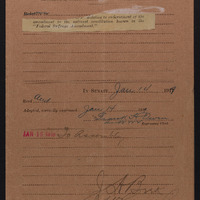
In addition to granting women the right to vote, the 1911 women’s suffrage amendment also paved the way for women to hold political office in California. In 1918, Esto B. Broughton, Elizabeth Hughes, Anna L. Saylor, and Grace S. Dorris became the first four women elected to the California State Assembly. Though fifteen states had already granted women full voting rights, a federal amendment was required to secure nationwide suffrage. To push for this national change, two almost identical resolutions were introduced on January 9, 1919 to urge the U.S. Congress to move forward with “the amendment to the National Constitution known as ‘The Federal Suffrage Amendment.’". On just her third day in office, newly elected Assemblywoman Grace S. Dorris introduced Assembly Joint Resolution No. 1. Simultaneously, Senate Joint Resolution No. 3 was introduced by Senator Burnett, a male colleague in the State Senate. While Dorris's historic Assembly bill ultimately died in committee, its twin Senate resolution successfully advanced, passing both chambers on January 17, 1919.
Date: January 1919