
Search All Items
- Filters:
- Language
- English 6219
- Spanish 19
- ENGLISH 2
- English 1
- contra_costa_schedule_1_volume_1 1
- Type
- Image 3871
- Still Image 1869
- Text 440
- Text 54
- Textual 2
- Image of the California Census from the records of the office of the California Secretary of State 1
Search Results 6171 to 6180 of 6312
-
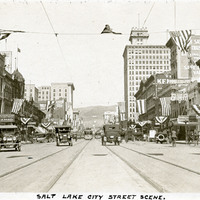
Caption: "Salt Lake City Street Scene.," c. 1916. Street scene in Salt Lake City, Utah. Flags and buntings suggest that the city was holding some kind of celebration at the time of the photograph. Several bicyclists appear at the photograph's right side.
Date: 1916
-
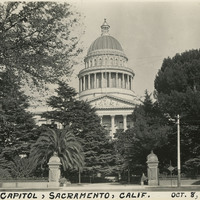
Caption: "State Capitol, Sacramento, Calif. Oct. 8, 1934." Construction began on the neoclassical California State Capitol Building, the dome of which is seen here (the rest of the building is largely obscured by trees), in 1860. Completed in 1874, the building still houses the state's legislature and the offices of the Governor.
Date: 10/8/1934
-
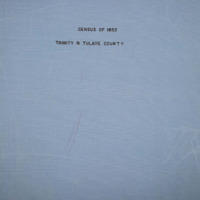
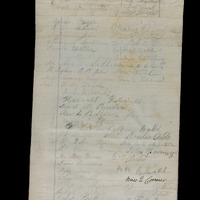
The Census of 1852 collection includes enumerations of California's 32 counties, arranged into 126 volumes. Schedule I enumerated the county's inhabitants, while schedule II enurmerated economic production. Many pages of this volume are damaged.
Date: 1852
-
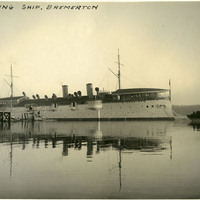
Caption: "Training Ship. Bremerton," Washington, c. 1908 - 1912. See also 96-07-08-alb08-086. View of the USS Philadelphia (C-4). The fourth ship to bear the name, the Philadelphia first launched in September 1889. She sailed as part of the U.S. Navy's Atlantic Squadron until 1893. She then sailed into the Pacific Ocean, where she served until being decommissioned and docked in Puget Sound in 1902. In 1904, the Navy "housed over" the ship (adding the roofed quarters visible on the upper deck in the photograph) and designated her a receiving ship for new sailors not yet assigned to a crew. The Philadelphia served in this capacity until 1912. After a brief stint as a prison ship, the Philadelphia again became a receiving ship in 1916. The Navy sold her in 1927.
Date: 1908
-
Ahead of the second California Constitutional Convention held in Sacramento from September 28, 1878 to March 3, 1879, petitions were circulated around California in support of amending Article II of the 1849 constitution. The petitions included over 2,500 signatures and asserted that “no citizen of the State shall be disenfranchised on the account of sex.” The petition shown here from October 10, 1878 contains hundreds of signatures and measures over seven feet long. However, the many signatures indicating support for the amendment were not enough to sway the all-male delegation at the 1878-1879 Constitutional Convention. Several delegates expressed fears about the impact of enfranchising women as well as concerns that the inclusion of women’s suffrage in the new 1879 constitution would threaten its ratification. After several days of debate, the amendment did not move forward.
Date: October 10, 1878
-
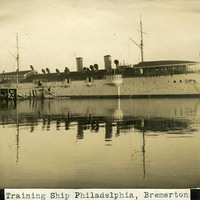
Caption: "Training Ship Philadelphia, Bremerton," c. 1908-1912. View of the USS Philadelphia (C-4). The fourth ship to bear the name, the Philadelphia first launched in September 1889. She sailed as part of the U.S. Navy's Atlantic Squadron until 1893. She then sailed into the Pacific Ocean, where she served until being decommissioned and docked in Puget Sound in 1902. In 1904, the Navy "housed over" the ship (adding the roofed quarters visible on the upper deck in the photograph) and designated her a receiving ship for new sailors not yet assigned to a crew. The Philadelphia served in this capacity until 1912. After a brief stint as a prison ship, the Philadelphia again became a receiving ship in 1916. The Navy sold her in 1927.
Date: 1908
-
This item has no description.
Date: 1974
-
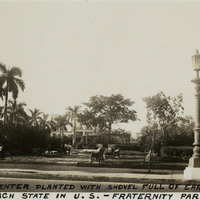
Caption: "Tree in Center Planted with Shovel Full of Earth From Each State in U.S. -- Fraternity Park -- Havana, July 4, 34." This photograph captures a view of Havana's Fraternity Park. The area originally served the city as a military parade and training ground (called Campo de Marte). In 1928, the park was renovated and a ceiba (or kapok) tree was planted in one of the central parcels. This tree, seen in the center of this photograph, was planted as the Tree of American Fraternity. When Havana hosted the sixth International American Conference later in 1928 (also known as one of the Pan-American Conferences), each of the twenty-one visiting dignitaries brought earth from their native counties in which to plant the tree (William McCarthy mistakenly identified the earth as coming from each state in the U.S.).
Date: 7/4/1934
-
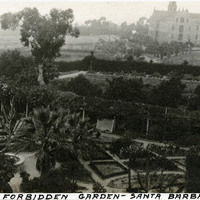
Caption: "Forbidden Garden -- Santa Barbara Mission," c. 1910. View of the gardens associated with Santa Barbara Mission. The gardens initially served as the location for instructing neophytes (Native American converts living at the mission) in trades and skills deemed necessary to life in European civilization. Later, the garden was used for meditation. The garden was often dubbed "forbidden" because it was closed to female visitors, as were many enclosures in active missions.
Date: 1910
-
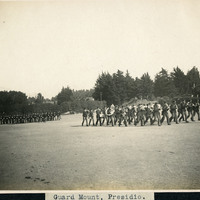
Caption: "Guard Mount. Presidio," c. 1906, shows two groups of men in formation on the Presidio grounds. One group of men is playing musical instruments, while the other group is carrying firearms. Established in 1776 by Spanish explorers, the Presidio is a fortified location overlooking the Golden Gate, the entrance into San Francisco Bay. It was closed as a military structure in 1995, and is now a park within the Golden Gate National Recreation Area.
Date: 1906