
Search All Items
- Filters:
- Type
- Image 2673
- Still Image 417
- Text 261
- Text 19
- Language
- English 3086
- Spanish 287
- ENGLISH 3
- English 1
- census_013 1
Search Results 2901 to 2910 of 3402
-
This item has no description.
Date: undated
-
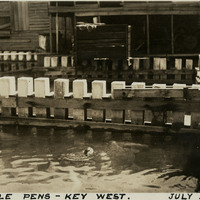
Caption: "Turtle Pens -- Key West. July 2, 1934." View of turtle kraals, or turtle corrals, used in the turtle fishing industry in Key West. Green turtles were kept in these pens prior to slaughter or transport. Turtle meat and eggs were popular food items in the early-to-mid twentieth century; turtle fat was especially prized for making turtle soup. However, the turtle population plummeted in the Florida Keys and surrounding areas as the twentieth century progressed and demand increased. The turtle kraals and nearby canneries closed when the Endangered Species Act was passed in 1971. Populations have since started to recover. The cannery near the kraals shown in this photograph now serves as the Key West Turtle Museum.
Date: 7/2/1934
-
A series of short notations about hospital patients under the supervision of Dr. Reid. Volumes one through four in this series run chronologically, starting in 1852 and ending in 1856. The entries include details such as patient name, nationality, and age, as well as mental disposition. A researcher with an interest in a particular hospital patient may find Reidà¿s journals useful. Dr. Robert K. Reid's medical journals do not include private thoughts about the medical profession or details about Reid's role as a physician at Stockton State Hospital. The fifth volume in the series contains Dr. Reid's Meteorological Observations. Beginning in 1850, Reid recorded daily meteorological observations, including three daily temperature recordings, taken at 8 a.m., 2 p.m., and 8 p.m.. He also recorded cloud, wind, and rain observations, and in 1853, began recording daily barometric pressures. Dr. Robert K. Reid's Meteorological Observations journal continues through 1856.
Date: 1850-1856
-
Caption: "400 Pound Turtles Ready for Shipment -- Key West July 2, 1934." Several slaughtered sea turtles on a wharf in Key West. Turtle meat and eggs were popular food items in the early-to-mid twentieth century; turtle fat was especially prized for making turtle soup. Turtle kraals (corrals) and a cannery were built as the Key West area began to develop. However, the turtle population plummeted in the Florida Keys and surrounding areas as the twentieth century progressed and demand for turtle meat, eggs, and fat increased. The Key West turtle fishing industry halted after the Endangered Species Act was passed in 1971. Turtle populations have since started to recover. The cannery now serves as the Key West Turtle Museum.
Date: 7/2/1934